When a company reports a workplace injury rate, the natural assumption is that it covers everyone doing the work — but a new analysis of the world’s largest industrial firms suggests that assumption may often be wrong.
Coverage by Measure
results by sector
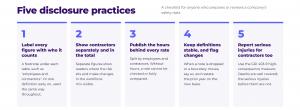
Five Disclosure Practices
SDS Manager study of 600 safety figures finds most firms label contractor deaths clearly, but only 7 of 40 publish the contractor hours behind injury rates.
Contractors often do the riskiest work, yet many companies don’t say if injury rates count them. Most report contractor deaths clearly. One line saying who a figure covers closes the gap.”— Arysha Alif Khan, Product Compliance Manager, SDS Manager
DOVER, DE, UNITED STATES, October 18, 2026 /EINPresswire.com/ — The Contractor Safety Disclosure Report 2026, published by SDS Manager, reveals a significant transparency gap: while contractor fatalities are typically disclosed without ambiguity, the injury rates that would give those numbers context often lack clarity. Only 7 of the 40 companies examined published the contractor hours worked that would allow outsiders to verify those rates.
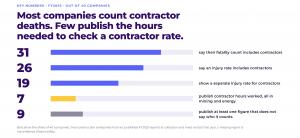
Just 26 of the 40 largest publicly traded mining, energy, construction and manufacturing companies explicitly state that their published injury rates include contractors. This matters because contractors frequently perform the highest-risk tasks at mines, plants and construction sites. When a rate reflects only direct employees, the company’s reported safety record can appear stronger than the reality of the work it oversees.
The Contractor Blind Spot: Contractor Safety Disclosure Report 2026 examined 600 individual safety metrics drawn from three years (FY2023–FY2025) of public sustainability reports, ESG data books and annual filings. The research covered 40 large listed companies, with 10 from each of four industrial sectors. For every figure, the researchers asked a single question: does the report specify whose injuries are included?
The findings show a clear hierarchy of disclosure. Fatalities are almost always labeled with their scope. Injury rates are labeled far less often. And the hours worked that would allow anyone to audit those rates are rarely published at all — a problem that directly affects investors, customers and safety professionals who rely on these figures for comparison.
Key findings
Key numbers for FY2025, out of 40 companies. Source: SDS Manager, Contractor Safety Disclosure Report 2026.
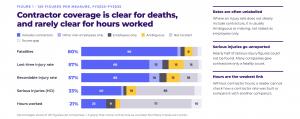
Deaths are counted clearly. In FY2025, 31 of 40 companies confirmed their fatality counts include contractors. Across the full three-year period, 80% of all fatality figures explicitly named contractors as included.
Injury rates are often silent. In FY2025, 14 companies published injury rates that did not clearly state whether contractors were included. The most frequent issue was not explicit exclusion but omission: 5 companies published a rate with no accompanying statement about who it covered. Only 2 companies stated outright that their rate covered employees only.
Hours are the missing piece. Only 7 companies in FY2025 published contractor hours worked, and all of them were in mining and energy. Without these hours, readers cannot verify how a contractor injury rate was calculated or make meaningful comparisons between companies. Over the three-year study period, just 21% of hours-worked figures specified that they included contractors.
Serious injuries are often missing. Researchers were unable to locate nearly half of the serious-injury figures they sought — 58 of 120. Many companies report contractor fatalities but provide no corresponding data on serious non-fatal injuries.
Year-over-year comparisons need care. Of the 400 FY2024 and FY2025 figures reviewed, 108 cannot be directly compared with the prior year, frequently because labels or reporting boundaries changed between periods.
Wording can mislead, too: the phrase “including non-employees” does not always mean contractors. Of 325 figures that referenced non-employees, 28 widened the count to include temporary or agency workers while still excluding contractors.
Contractor coverage by measure, FY2023–FY2025. Source: SDS Manager, Contractor Safety Disclosure Report 2026.
Construction and manufacturing disclose the least about contractor safety
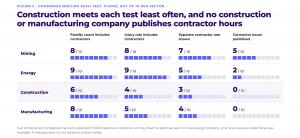
None of the 20 construction and manufacturing companies published contractor hours in FY2025. Construction companies met each disclosure test less often than any other sector, while mining and energy companies labeled their figures most clearly.
Companies meeting each test in FY2025, out of 10 per sector. Source: SDS Manager, Contractor Safety Disclosure Report 2026.
Two construction companies had not published their FY2025 reports when data collection took place, so they meet no test for that year.
Year-over-year totals look stable, but how companies label safety figures keeps changing
Although headline totals across the sector appeared steady, 16 companies changed their approach to at least one key disclosure test between FY2023 and FY2025. Some changes improved clarity. Others moved in the opposite direction: one manufacturer shifted from naming contractors, to stating employees only, to providing no statement at all. Reporting boundaries also shifted frequently — of the 600 figures reviewed, 167 were limited to operated sites and 91 were affected by acquisitions or disposals.
Five practices for clearer safety reporting
None of these recommendations requires collecting new data — only clearer labeling of data companies already possess:
- Label every figure with who it counts, such as “employees and contractors” in a footnote under each table.
- Show contractors separately and in the total, so readers can see where the risk sits.
- Publish the hours behind every rate, split by employees and contractors.
- Keep definitions stable and flag changes, restating the prior year on the new basis.
- Report serious injuries for contractors too, using the GRI 403-9 high-consequence injury measure.
Source: SDS Manager, Contractor Safety Disclosure Report 2026.
About the study
The 40 companies were selected by market value before any reports were read, and their identities are not disclosed. Researchers reviewed 135 public reports and data files published as of early October 2026, covering five measures: fatalities, serious injuries, recordable injury rates, lost-time injury rates and hours worked.
Each figure was coded twice in blind, independent AI-assisted passes using a single written guide. The two passes agreed on 82.8% of figures (497 of 600), and any disagreements were resolved against the source page. Human reviewers then checked randomly drawn figures against their sources. Every coded figure includes a link to the page or cell from which it came.
The study measures how clearly companies label their safety figures. It does not measure or rank how safe any company is. A figure that could not be found is not a zero, and an unclear label is not evidence of poor safety.
About SDS Manager
SDS Manager helps organizations manage safety data sheets and chemical safety compliance. Its EHS Solutions help companies track contractor safety alongside their own workforce.
Learn more at sdsmanager.com
Tasmim Wahed
SDS Manager
Visit us on social media:
LinkedIn
Facebook
YouTube
X
Why it matters: When safety data is ambiguous or incomplete, investors, regulators and workers’ advocates cannot accurately assess the risks at major industrial sites. The report’s findings suggest that a simple labeling change — clarifying who is counted in each figure — could substantially improve transparency without any new data collection, and it points to a broader need for standardized disclosure rules across the sector.