The vehicle conversion industry is quietly becoming a major force in the automotive world, with projections showing the sector will surpass $9 billion by 2030. This growth is fueled by everything from electric vehicle retrofits to personalized camper van builds, reshaping how consumers and fleets think about their vehicles.
At the heart of this transformation are companies that specialize in mobility solutions, commercial vehicle modifications, and automotive upgrades. These providers are focusing on custom adaptations, modular interiors, accessibility improvements, and specialized equipment integration to meet the diverse needs of their customers. They compete on passenger comfort, functionality, conversion quality, and regulatory compliance, all while driving innovation in the vehicle customization space.
The Business Research Company’s Vehicle Conversion Global Market Report 2026 – Market Size, Trends, And Forecast 2026-2035
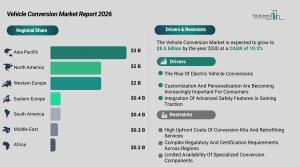
LONDON, GREATER LONDON, UNITED KINGDOM, October 13, 2026 /EINPresswire.com/ — The vehicle conversion market is projected to exceed $9 billion by 2030, according to new analysis. This represents a portion of the larger Industrial Vehicle market, which is expected to reach approximately $69 billion in the same year, with vehicle conversion estimated to account for around 12% of that segment. Within the broader Transport industry—valued at $9,400 billion in 2030—this market will represent nearly 0.1% of the total. A compound annual growth rate (CAGR) of 10% is forecasted through 2030, signaling a strong upward trajectory for the sector.
Request A Free Sample Of The Vehicle Conversion Market Report
https://thebusinessresearchcompany.com/sample_request?id=12501&type=smp&name=Vehicle%20Conversion%20Market%20Report%202026&utm_source=EINPresswire&utm_medium=Paid&utm_campaign=Oct_PR
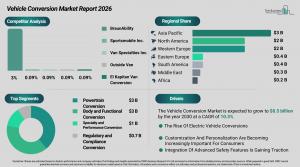
Geographically, the Asia-Pacific region is poised to dominate the vehicle conversion market by 2030, with projections showing it will reach $2.6 billion, up from $1.4 billion in 2025—a CAGR of 13%. This surge is driven by emerging economies embracing customized mobility solutions, electric vehicle conversion initiatives, rising demand for specialized commercial and utility vehicles, and investments in flexible platforms and advanced technology.
Meanwhile, the United States will maintain its position as the largest country market by 2030, valued at $2.2 billion, up from $1.5 billion in 2025, growing at an 8% CAGR. Growth in the U.S. is supported by the popularity of recreational vehicle upgrades, demand for wheelchair-accessible vehicles, fleet modernization efforts, electric retrofitting services, and converters’ specialized offerings for both consumer and commercial sectors.
Access The Detailed Vehicle Conversion Market Report Here
https://thebusinessresearchcompany.com/report/vehicle-conversion-global-market-report?utm_source=EINPresswire&utm_medium=Paid&utm_campaign=Oct_PR
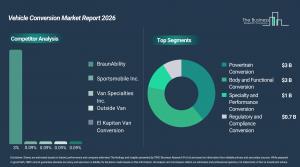
The market breaks down by conversion type into powertrain conversion, body and functional conversion, specialty and performance conversion, and regulatory and compliance conversion. Powertrain conversion is expected to be the largest segment in 2030, holding a 38% market share, or about $3 billion. This segment benefits from the shift toward electric mobility, combustion-to-electric retrofits, drivetrain enhancements that prolong vehicle life, sustainable transport preferences, and technological advances in batteries and electric motors.
Additional segmentation includes:
– Vehicle Type: passenger cars, commercial vehicles, and other categories
– End Users: individual consumers, fleet operators, government/public sector, and commercial/industrial users
Several key forces are propelling the vehicle conversion market’s rapid expansion through 2030. One major driver is the increasing popularity of electric vehicle conversions. Both consumers and fleet operators are adopting electric powertrains to extend vehicle lifespans and reduce emissions. Retrofitting presents a cost-effective alternative to purchasing new electric vehicles, aided by better accessibility to batteries, motors, and conversion kits. This trend is expected to add roughly 2.5% annual growth to the market.
Growing demand for customization and personalization also plays a vital role. Vehicle owners seek tailored modifications that enhance comfort, aesthetics, functionality, and the overall driving experience. Converters are responding with expanded services such as personalized interiors, upgraded entertainment systems, unique layouts, and distinctive designs, reflecting lifestyle trends in the automotive sector. This factor may contribute about 2.0% annual growth.
The integration of advanced safety features is becoming increasingly important. Heightened attention to driver assistance, monitoring technologies, parking aids, and visibility improvements is driving demand. Converters are incorporating modern safety systems into existing vehicles, and the availability of retrofit kits is facilitating adoption among individual and fleet users. This influence is anticipated to add around 1.5% annual growth.
In 2025, BraunAbility secured the top spot globally with a 3% market share. Its vehicle conversion division specializes in wheelchair-accessible vehicles, mobility adaptations, seating modifications, and custom transport solutions that enhance accessibility, convenience, and mobility for both personal and commercial vehicles.
The vehicle conversion market remains fragmented, with the top 10 companies collectively accounting for only 4% of total revenue in 2025. This fragmentation stems from diverse customer requirements, the specialized skill set needed for modifications, engineering expertise, and the necessity for certified installations. Market leaders maintain their positions through tailored conversion portfolios, robust customer relationships, specialized design capabilities, and strong expertise in mobility, recreational, and commercial vehicle adaptations. As demand grows for personalized transport, accessible mobility vehicles, camper conversions, and custom modifications, innovation, partnerships, and expanded facilities will help strengthen their foothold.
Key competitors by 2025 market revenue share include:
– BraunAbility (3%)
– Sportsmobile Inc. (0.1%)
– Van Specialties Inc. (0.1%)
– Outside Van (0.1%)
– El Kapitan Van Conversion (0.1%)
– Creative Mobile Interiors Inc. (0.1%)
– RB Components Inc. (0.1%)
– Vanworks Inc. (0.1%)
– Colorado Camper Van LLC (0.1%)
– Nomad Vanz (0.1%)
Modular vehicle architecture is transforming the vehicle conversion industry by enabling flexible configurations that accommodate diverse transportation needs and adapt easily to changing mobility demands. For instance, in January 2024, Kia Corporation unveiled its PV5 modular electric van at CES. This vehicle features interchangeable life modules including cargo van, high-roof mobile office, robotaxi, passenger model, and chassis cab setups. Its modular body design, advanced coupling mechanisms, and software-driven platform enhance customization options, support multiple use cases, and provide adaptable mobility solutions.
Key priorities for companies in this sector include:
– Delivering sophisticated customization through modular platforms
– Retrofitting electric powertrains to promote sustainable transportation
– Incorporating smart technologies into connected converted vehicles
– Building strategic partnerships to broaden specialized conversion capabilities
– Enhancing interior engineering to improve comfort and functionality
Main growth opportunities lie in powertrain, body and functional, specialty and performance, and regulatory and compliance conversions. Together, these segments are forecasted to contribute over $2.8 billion in added value by 2030. Powertrain conversions are expected to add roughly $1 billion, with body and functional conversions contributing another $1 billion. Specialty and performance conversions may grow by $0.5 billion, and regulatory and compliance upgrades by $0.3 billion from 2025 to 2030. These increases reflect trends such as electric drivetrain retrofits, personalized modifications, specialized mobility solutions, technological advances, and compliance-driven improvements focused on enhancing vehicle longevity, operational adaptability, and next-generation mobility.
Prominent companies active in the vehicle conversion market include BraunAbility, Sportsmobile Inc., Van Specialties Inc., Outside Van, El Kapitan Van Conversion, Creative Mobile Interiors Inc., RB Components Inc., Vanworks Inc., Colorado Camper Van LLC, Nomad Vanz, Zero Labs Automotive, Electric GT Holdings Inc., Zelectric Motors LLC, Hi Performance Electric Vehicle Systems, DIYEV Inc., EV4U Custom Conversions, EVDrive Inc., Flash Drive Motors, Green Shed Conversions, Glampervan, Green Motors Inc., Advanture Company, and Electric Classic Cars.
Key suppliers providing raw materials to this market include ArcelorMittal, Nucor Corporation, Novelis Inc., Constellium SE, Hydro Aluminium, SABIC, Covestro AG, BASF SE, Dow Inc., 3M Company, Avery Dennison Corporation, Saint-Gobain, Owens Corning, Toray Industries Inc., Teijin Limited, Hexcel Corporation, Huntsman Corporation, Celanese Corporation, DuPont, and LyondellBasell Industries.
Major wholesalers and distributors in this space include LKQ Corporation, Genuine Parts Company, AutoZone Inc., O’Reilly Automotive Inc., Advance Auto Parts Inc., NAPA Auto Parts, Parts Authority, Keystone Automotive Operations Inc., Meyer Distributing Inc., Turn 14 Distribution, Summit Racing Equipment, Jegs Automotive Inc., Euro Car Parts, Parts Europe GmbH, Alliance Automotive Group, Wurth Group, Uni-Select Inc., and Motor State Distributing.
Leading end users encompass major logistics and transportation companies such as FedEx Corporation, United Parcel Service Inc., DHL Group, Amazon Logistics, Enterprise Mobility, Hertz Corporation, Avis Budget Group Inc., Uber Technologies Inc., Lyft Inc., First Student Inc., National Express Group, Transdev Group, Keolis Group, Ryder System Inc., Penske Truck Leasing, U-Haul International, Siemens Mobility, and United Rentals Inc.
New analytical features added to our 2026 market reports:
• Market attractiveness scoring and analysis
• Total addressable market (TAM) analysis
• Company scoring matrix graphics and tables
• Excel-based forecasting dashboards
• Market hotspots infographics
• Key technologies and future trend analysis
• Updated graphics and tables
Learn More About The Business Research Company
The Business Research Company (www.thebusinessresearchcompany.com) is a leading market intelligence firm renowned for its expertise in company, market, and consumer research. We have published over 30,000+ reports across 27 industries and 60+ geographies. Our research is powered by 1,500,000 datasets, extensive secondary research, and exclusive insights from interviews with industry leaders.
We provide continuous and custom research services, offering a range of specialized packages tailored to your needs, including Market Entry Research Package, Competitor Tracking Package, Supplier & Distributor Package and much more.
Disclaimer: Please note that the findings, conclusions and recommendations that TBRC Business Research Pvt Ltd delivers are based on information gathered in good faith from both primary and secondary sources, whose accuracy we are not always in a position to guarantee. As such TBRC Business Research Pvt Ltd can accept no liability whatever for actions taken based on any information that may subsequently prove to be incorrect. Analysis and findings included in TBRC reports and presentations are our estimates, opinions and are not intended as statements of fact or investment guidance.
Contact Us:
The Business Research Company
Americas +1 310-496-7795
Europe +44 7882 955267
Asia & Others +44 7882 955267 & +91 8897263534
Email: marketing@tbrc.info
Follow Us On:
LinkedIn: https://in.linkedin.com/company/the-business-research-company
Oliver Guirdham
The Business Research Company
+44 7882 955267
info@tbrc.info
Visit us on social media:
LinkedIn
Facebook
X
Why it matters: As electric vehicle adoption accelerates and consumers increasingly seek personalized, accessible, and sustainable transportation options, the vehicle conversion market is positioned as a key enabler of these trends. The projected growth signals that retrofitting and customization will play an essential role in extending vehicle lifespans and meeting diverse mobility needs, offering opportunities for both established players and new entrants in the automotive ecosystem.