The wearable technology sector is no longer just about counting steps — it’s becoming a cornerstone of the broader digital health and connected living landscape. New projections from The Business Research Company indicate the market is on track to more than double in size by the end of the decade, driven by everything from advanced display tech to AI-powered health monitoring.
According to the firm’s Wearable Technology Global Market Report 2026, the industry is evolving rapidly as companies race to integrate cutting-edge features like artificial intelligence analytics, superior sensors, and seamless connectivity into their devices. The competitive landscape is fierce, with major players focusing on innovation, integration with digital health platforms, extended battery life, and robust data privacy and security measures.
The Business Research Company’s Wearable Technology Global Market Report 2026 – Market Size, Trends, And Forecast 2026-2035
Also worth a look: Switches market to hit $30B by 2030 as Asia-Pacific leads growth surge and Precision ball screw market nears $2B by 2030 as China and automation lead surge.
LONDON, GREATER LONDON, UNITED KINGDOM, October 28, 2026 /EINPresswire.com/ — The market’s trajectory is steep. By 2030, the wearable technology market is projected to surpass $224 billion, representing a significant chunk of the broader Smart Home Devices market, which is expected to reach approximately $391 billion that same year. Wearables are forecast to account for about 57% of that segment. Within the larger Electrical and Electronics industry — valued at a projected $5,959 billion by 2030 — wearables will make up close to 4% of the total. The market is anticipated to grow at a compound annual growth rate of 15% through 2030.
Request A Free Sample Of The Wearable Technology Market Report
https://thebusinessresearchcompany.com/sample_request?id=68496582&type=smp&name=Wearable%20Technology%20Market%20Report%202026&utm_source=EINPresswire&utm_medium=Paid&utm_campaign=Oct_PR
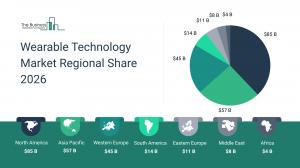
North America is expected to lead the global wearable technology market in 2030, with a projected value of $85 billion, a substantial jump from $43 billion in 2025, reflecting a 15% CAGR. This growth is underpinned by widespread adoption of connected electronics, extensive use of wearables for remote patient monitoring and digital health initiatives, strong ties to fitness and wellness communities, enterprise applications for workforce safety and productivity, robust high-speed wireless networks, and persistent demand for premium smartwatches, fitness trackers, and smart eyewear across the United States and Canada.
Within North America, the United States is set to be the largest country market for wearable technology in 2030, valued at $72 billion — doubling from $36 billion in 2025, also at a 15% CAGR. This expansion is fueled by increasing adoption of AI-powered wearables, growing demand for continuous biometric and health monitoring, investments in digital healthcare and telehealth, applications in sports performance and professional athletics, dynamic semiconductor and sensor innovations, and strengthened collaboration among tech companies, healthcare providers, and insurers.
Access The Detailed Wearable Technology Market Report Here
https://thebusinessresearchcompany.com/report/wearable-technology-market-report?utm_source=EINPresswire&utm_medium=Paid&utm_campaign=Oct_PR
The wearable technology market is diverse, encompassing product types from smartwatches and fitness trackers to smart clothing, AR/VR headsets, medical wearables, hearables, and other accessories. Smartwatches are projected to remain the most dominant category in 2030, representing 35% of the market or $78 billion. This segment’s growth is bolstered by improved battery efficiency, low-power chipsets, integration with contactless payment and digital wallets, consumer preference for multifunctional wrist devices, compatibility with smart home ecosystems, demand for customizable applications, and continual advancements in display technology, ruggedness, and premium features.
Other market segments are defined by connectivity options (Bluetooth, Wi-Fi, cellular including LTE and 5G, near field communication, and other low-power IoT networks), distribution channels (online retail, brand or OEM stores, consumer electronics retailers, healthcare networks, and enterprise sales), and application areas (health and fitness monitoring, medical diagnostics, sports analytics, gaming and immersive training, workplace safety, lifestyle assistance, and defense operations). End-users range from individual consumers and healthcare providers to enterprises and athletic organizations.
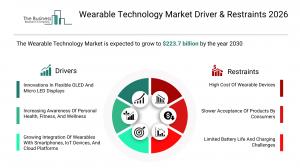
One of the main growth catalysts for the wearable technology market through 2030 is the advancement of flexible OLED and micro-LED display technologies. These displays offer sharper visuals, higher brightness, lower power consumption, and improved color accuracy, enabling lighter, slimmer, and more comfortable devices for all-day wear. Innovations such as curved and foldable screens are expanding design possibilities across smartwatches, fitness trackers, and smart glasses, while enhanced durability boosts consumer confidence. This factor alone is expected to add approximately 1.5% growth annually.
Rising health awareness is another powerful driver. Consumers increasingly seek continuous health insights, relying on wearables to monitor heart rate, sleep quality, physical activity, and calorie consumption, promoting healthier lifestyles and early detection of health issues. The popularity of fitness activities, combined with encouragement from employers, insurers, and wellness programs, further fuels demand, contributing around 1.0% annual growth to the market.
The integration of wearables with smartphones, Internet of Things (IoT) networks, and cloud platforms enhances functionality by synchronizing health data, notifications, and activities across devices. Cloud-based storage offers secure access to historical data and advanced analytics, while connections with smart home devices broaden everyday usability. Real-time data sharing enables personalized recommendations and automated services, with this connected ecosystem expected to contribute roughly 0.8% growth each year.
A new wave of AI-powered neural interface wristbands is transforming user interaction by enabling intuitive, hands-free control of connected devices. For example, in January 2025, Wearable Devices Ltd. introduced the Mudra Link, a neural gesture-control wristband compatible with Android, macOS, and Windows platforms. This device facilitates gesture-based navigation, enhances accessibility, and supports smooth interaction with augmented reality environments and smart systems.
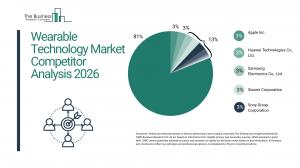
According to The Business Research Company, Apple Inc. secured the top position globally in 2025, holding a 3% market share. Apple’s wearable division offers a broad portfolio including smartwatches, wireless earbuds, fitness trackers, and health monitoring solutions designed for consumer wellness, digital connectivity, and everyday lifestyle applications.
Major companies active in this market include Apple Inc., Huawei Technologies Co., Ltd., Samsung Electronics Co., Ltd., Xiaomi Corporation, Sony Group Corporation, Google LLC, Garmin Ltd., OPPO Guangdong Mobile Communications Co., Ltd., ASUSTeK Computer Inc., LG Electronics Inc., OnePlus Technology (Shenzhen) Co., Ltd., Imagine Marketing Limited, NIKE, Inc., adidas AG, Polar Electro Oy, Suunto Oy, Casio Computer Co., Ltd., Withings SA, Vuzix Corporation, and Michael Kors Holdings Limited.
The wearable technology market is moderately fragmented, with the top 10 players generating about 19% of total revenue in 2025. This structure reflects the challenges and barriers in technology innovation, sensor integration, software ecosystems, health regulations, and performance reliability required for consumer and medical applications. Leading companies maintain significant market shares through diverse product lines, global distribution networks, strong brand presence, and continuous innovation aimed at health monitoring, fitness tracking, AI capabilities, and connectivity. As demand for advanced wearables grows, strategies like partnerships, product development, and regional market expansions are expected to reinforce their positions.
In 2025, market shares among the leading companies are estimated as follows: Apple Inc. (3%), Huawei Technologies Co., Ltd. (3%), Samsung Electronics Co., Ltd. (3%), Xiaomi Corporation (3%), Sony Group Corporation (3%), Google LLC (2%), Garmin Ltd. (1%), OPPO Guangdong Mobile Communications Co., Ltd. (1%), ASUSTeK Computer Inc. (0.4%), and LG Electronics Inc. (0.3%).
Industry leaders are focusing on enhancing sensor technologies for improved health tracking and user experience, leveraging AI and connected ecosystems for richer insights, expanding healthcare and fitness applications to boost adoption, and integrating advanced connectivity for seamless data synchronization and remote monitoring.
Smartwatches, fitness and activity trackers, smart textiles or e-clothing, augmented reality and virtual reality headsets or smart glasses, medical and clinical wearables, hearables or smart earbuds, and other wearable accessories are the main growth drivers. Together, these categories are expected to add more than $112 billion in value by 2030. Between 2025 and 2030, smartwatches are forecast to grow by $38 billion, fitness trackers by $20 billion, smart clothing by $25 billion, AR and VR devices by $13 billion, medical wearables by $10 billion, hearables by $3 billion, and other accessories by $3 billion. Growth catalysts include flexible electronics, miniaturized sensors, AI personal assistants, immersive extended reality, smart textiles for industrial and sports uses, investment in advanced chipsets, and innovation in connected audio and intelligent wearable systems.
The supply chain for wearable technology spans raw material providers such as Qualcomm Technologies Inc., MediaTek Inc., Sony Semiconductor Solutions Corporation, STMicroelectronics N.V., Infineon Technologies AG, NXP Semiconductors N.V., Texas Instruments Incorporated, Analog Devices Inc., Microchip Technology Incorporated, Murata Manufacturing Co. Ltd., TDK Corporation, ROHM Co. Ltd., Skyworks Solutions Inc., Qorvo Inc., ams-OSRAM AG, BOE Technology Group Co. Ltd., Corning Incorporated, Universal Display Corporation, Japan Display Inc., LG Display Co. Ltd., AAC Technologies Holdings Inc., Goertek Inc., Luxshare Precision Industry Co. Ltd., Foxconn Interconnect Technology Limited, and Dynapack International Technology Corporation.
Wholesalers and distributors include companies such as Ingram Micro Holding Corporation, TD SYNNEX Corporation, Arrow Electronics Inc., Avnet Inc., Future Electronics Inc., DigiKey Electronics, Mouser Electronics Inc., RS Group plc, Farnell Global, Rutronik Elektronische Bauelemente GmbH, Heilind Electronics Inc., Macnica Holdings Inc., WPG Holdings Limited, D&H Distributing Co., ScanSource Inc., Exclusive Networks SA, ALSO Holding AG, Redington Limited, Esprinet S.p.A., Westcon Group Inc., EET Group A/S, ASBIS Enterprises PLC, Bechtle AG, Mindware FZ LLC, and Logicom Public Limited.
End users encompass Fitbit LLC, Xiaomi Corporation, Polar Electro Oy, Suunto Oy, Withings S.A., Oura Health Ltd., Whoop Inc., Amazfit, Fossil Group Inc., Casio Computer Co. Ltd., Seiko Epson Corporation, Mobvoi Information Technology Company Limited, Nothing Technology Limited, Realme Mobile Telecommunications Corporation Limited, OnePlus Technology Shenzhen Co. Ltd., Noise, boAt Lifestyle, Oppo Guangdong Mobile Communications Co. Ltd., Vivo Communication Technology Co. Ltd., and Honor Device Co. Ltd.
What’s new in our 2026 market reports:
• Market attractiveness scoring and analysis
• Total addressable market (TAM) analysis
• Company scoring matrix graphics and tables
• Excel dashboards
• Market hotspots infographics
• Key technologies and future trends
• Updated graphics and tables
Learn More About The Business Research Company
The Business Research Company (www.thebusinessresearchcompany.com) is a leading market intelligence firm renowned for its expertise in company, market, and consumer research. We have published over 30,000+ reports across 27 industries and 60+ geographies. Our research is powered by 1,500,000 datasets, extensive secondary research, and exclusive insights from interviews with industry leaders.
We provide continuous and custom research services, offering a range of specialized packages tailored to your needs, including Market Entry Research Package, Competitor Tracking Package, Supplier & Distributor Package and much more.
Disclaimer: Please note that the findings, conclusions and recommendations that TBRC Business Research Pvt Ltd delivers are based on information gathered in good faith from both primary and secondary sources, whose accuracy we are not always in a position to guarantee. As such TBRC Business Research Pvt Ltd can accept no liability whatever for actions taken based on any information that may subsequently prove to be incorrect. Analysis and findings included in TBRC reports and presentations are our estimates, opinions and are not intended as statements of fact or investment guidance.
Contact Us:
The Business Research Company
Americas +1 310-496-7795
Europe +44 7882 955267
Asia & Others +44 7882 955267 & +91 8897263534
Email: marketing@tbrc.info
Follow Us On:
LinkedIn: https://in.linkedin.com/company/the-business-research-company
Oliver Guirdham
The Business Research Company
+44 7882 955267
info@tbrc.info
Visit us on social media:
LinkedIn
Facebook
X
Why it matters: As wearables become more integrated into healthcare, fitness, and daily connectivity, this projected growth signals a fundamental shift in how consumers and enterprises interact with technology. The data underscores that the sector is not just a niche accessory market but a major economic force within the broader electronics industry.