Healthcare is moving out of the hospital and into the clinic, the home, and the screen — and the software that powers that shift is becoming a bigger business by the year. A new market analysis from The Business Research Company sizes up just how fast that digital transformation is happening.

The Business Research Company’s Ambulatory Healthcare Information Technology (IT) Global Market Report 2026 – Market Size, Trends, And Forecast 2026-2035
The ambulatory healthcare information technology (IT) market has seen robust growth in recent years, propelled by the accelerating integration of digital tools into outpatient care. With providers under pressure to streamline operations and improve patient outcomes, innovative IT systems are reshaping how ambulatory services are delivered. The following breakdown covers market valuation, growth drivers, geographic patterns, and the trends likely to define the sector’s next phase.
Also worth a look: RED Awards honor 29 NYC real estate leaders, from brokers to builders, at 2026 ceremony and HPSI secures CE certification for Perkins container generators, targeting global power projects.
Market Size and Growth Trajectory of the Ambulatory Healthcare Information Technology Market
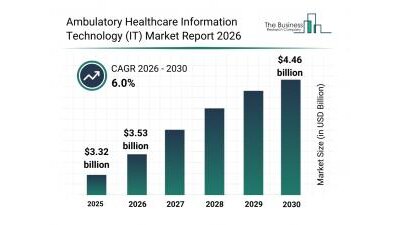
The ambulatory healthcare information technology market has grown considerably over the past several years. According to projections, it will climb from $3.32 billion in 2025 to $3.53 billion in 2026, reflecting a compound annual growth rate (CAGR) of 6.2%. That historical expansion has been driven by the move to digitize outpatient operations, broader adoption of scheduling and billing software, the proliferation of ambulatory service networks, early uptake of healthcare cybersecurity measures, and the general scaling of health information systems.
Download a free sample of the ambulatory healthcare information technology (it) market report:
https://thebusinessresearchcompany.com/sample_request?id=25393152&type=smp&name=Ambulatory%20Healthcare%20Information%20Technology%20%28IT%29%20Market%20Report%202026&utm_source=EINPresswire&utm_medium=Paid&utm_campaign=Oct_PR
Looking further out, the market is poised to sustain its momentum, reaching $4.46 billion by 2030 at a CAGR of 6.0%. That forecast period will be shaped by rising investment in interoperable health IT systems, heightened attention to cybersecurity compliance, the emergence of data-informed outpatient care models, more sophisticated patient engagement platforms, and the expanding use of analytics to sharpen operational performance. Notable trends on the horizon include the rise of integrated ambulatory IT platforms, AI-driven workflow automation, growing demand for secure health data exchange, the spread of cloud-native healthcare applications, and a stronger emphasis on patient engagement tools.
Understanding Ambulatory Healthcare Information Technology and Its Benefits
Ambulatory healthcare IT refers to technology applications built specifically for outpatient settings. Its core mission is to elevate the quality of medical care, lower costs, boost operational efficiency, reduce mistakes, and improve patient satisfaction. By simplifying workflows and delivering real-time data, these systems enable providers to offer more coordinated and effective care outside traditional hospital walls.
View the full ambulatory healthcare information technology (it) market report:
https://thebusinessresearchcompany.com/report/ambulatory-healthcare-information-technology-it-global-market-report?utm_source=EINPresswire&utm_medium=Paid&utm_campaign=Oct_PR
How Telehealth is Accelerating Ambulatory Healthcare IT Market Expansion
A key force behind the market’s growth is the surging adoption of telehealth. Telehealth allows providers to conduct virtual consultations, remote monitoring, diagnosis, and treatment using digital communication tools. This approach has become a cornerstone of modern outpatient care as patients look for faster, more convenient access to clinicians without the need for in-person visits.
That rising telehealth demand is pushing healthcare organizations to broaden their digital offerings. Ambulatory healthcare IT solutions now support integrated virtual care functions such as online scheduling, electronic prescriptions, secure messaging, and real-time remote patient monitoring. These capabilities improve care coordination while also enriching the patient experience. For example, in April 2023, the U.S. Department of Health and Human Services reported that 22% of American adults had used telehealth at least once, highlighting the role telehealth plays in fueling market expansion.
Regional Market Shares and Growth Prospects in Ambulatory Healthcare IT
North America held the largest regional share of the ambulatory healthcare information technology market in 2025. Yet the Asia-Pacific region is expected to post the fastest growth in the years ahead, supported by rising healthcare infrastructure spending and accelerating digital adoption. The analysis also covers South East Asia, Western Europe, Eastern Europe, South America, the Middle East, and Africa, each adding to the shifting global dynamics of the sector.
The 2026 market reports now include expanded strategic intelligence, featuring market attractiveness scoring and analysis, total addressable market (TAM) analysis, company scoring matrix graphics and tables, Excel-based dashboards, market hotspots infographics, key technology and future trend analysis, along with updated graphics and tables.
Speak With Our Expert:
Saumya Sahay
Americas +1 310-496-7795
Asia +44 7882 955267 & +91 8897263534
Europe +44 7882 955267
Email: marketing@tbrc.info
The Business Research Company – www.thebusinessresearchcompany.com
Follow Us On:
• LinkedIn: https://in.linkedin.com/company/the-business-research-company
Oliver Guirdham
The Business Research Company
+44 7882 955267
Visit us on social media:
LinkedIn
Facebook
X
Why it matters: As outpatient care becomes the default setting for more medical services, the software that supports it is no longer optional infrastructure — it is central to how healthcare is delivered. The projected growth signals sustained demand for tools that make care more accessible, efficient, and secure, which ultimately shapes the patient experience and the bottom line for providers alike.