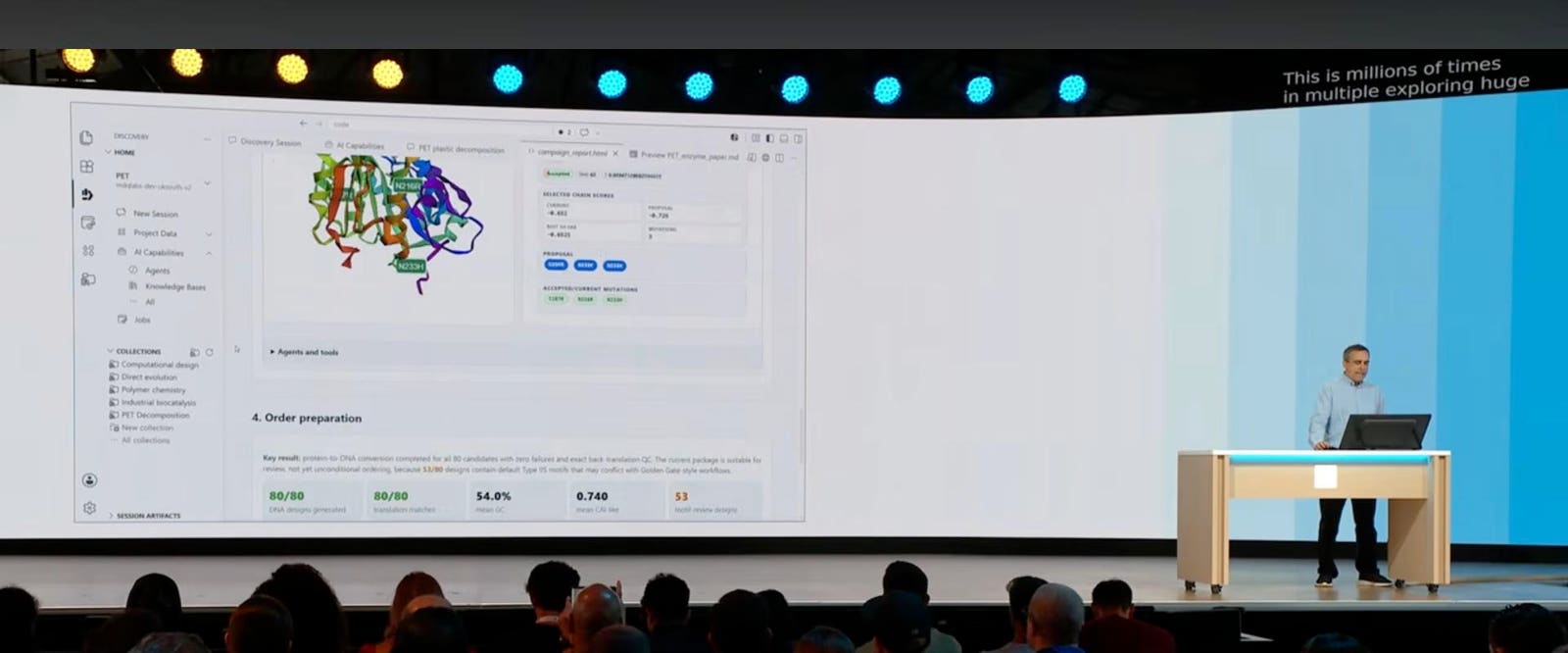
The growing intricacy of scientific research, combined with the enormous amount of data generated, has made it increasingly challenging for human teams to process and integrate findings. Microsoft’s latest offering, Discovery, is a cloud-based enterprise agentic AI platform built specifically to aid scientific research, particularly in fields that handle large datasets like chemistry, materials science, life sciences, biology, and semiconductors. This represents a serious effort to bridge the gap in research synthesis. It equips scientific teams with an AI-native infrastructure that can shorten the timeline from forming a hypothesis to reaching tangible discoveries.
Initially launched as a private preview at Microsoft Build 2025, Discovery became generally available one year later, in June 2026, at Build 2026. Following a detailed evaluation of its features and an analysis of its possible influence on challenging scientific problems, I believe Microsoft Discovery will be considered one of the most impactful research tools of 2026. It delivers robust solutions for challenges that go beyond what human researchers can handle on their own.
(Note: Microsoft is an advisory client of my firm, Moor Insights & Strategy.)
What Microsoft Discovery Enables: Beyond The Copilot Prompt
Microsoft Discovery relies on autonomous teams of AI agents that act as digital lab assistants, accelerating research and automating intricate workflows. Unlike standard AI assistants, these Discovery agents take an active role throughout the entire iterative scientific process, which encompasses data synthesis, hypothesis generation, experimental design, simulation, analysis, validation, and iteration.
Because it is built on Microsoft Azure, Microsoft Discovery is engineered for enterprise-level governance, security, and transparency. This should enable it to deliver high confidence in its outputs while integrating into current R&D workflows, rather than supplanting them.
MORE FOR YOU
The Discovery Engine acts as Microsoft Discovery’s central knowledge map. This graph-based knowledge system ensures that every AI agent knows what data is available, how it connects to the overall picture, and which logical step to take next. When required, the engine can shift resources for gathering evidence toward the most critical tasks during any phase of the scientific process.
Through multi-agent orchestration, Microsoft Discovery can field specialized teams of agents that leverage multiple parallel connections to institutional knowledge bases, domain-specific datasets, simulation tools, lab automation systems, and external scientific databases. Multi-step agentic workflows across these parallel links allow the platform to combine and analyze fragmented data that is spread across many sources. In such cases, Microsoft states, the platform can dramatically cut down the time needed to move from an initial hypothesis concept all the way to experimental and even physical discoveries.
Promoting Efficiency And Scale In Real-World R&D
Microsoft has clearly acknowledged that scientific research is not solely an issue of accessing information, but also a matter of managing complexity. To be effective, research teams must review prior work, pinpoint gaps, design experiments, gather data, analyze outcomes, and refine their approach—often under considerable time constraints. All of this must be accomplished while handling vast amounts of literature and experimental spaces that have surpassed human capacity. The Microsoft Discovery platform aims to manage this complexity to enable faster and more productive scientific processes.
Instead of being focused on a single area of study, Microsoft Discovery functions as a cross-domain scientific platform. To highlight this, Microsoft has shared several examples where Discovery has already been applied. These include Yale Engineering’s work on battery materials and Pacific Northwest National Laboratory’s research into energy storage and biosystems engineering.
How Microsoft Discovery Enhanced The Majorana 2 Quantum Chip
Another significant demonstration of Discovery’s capabilities came from within Microsoft itself. The platform played a key role in developing the company’s next-generation topological quantum chip, Majorana 2, which was also introduced at Microsoft Build 2026.