Cyber defenses are evolving beyond simple perimeter protection, and deception technology—which uses decoys and traps to mislead attackers—is emerging as a critical tool in that shift. A new report from The Business Research Company projects this niche but fast-growing sector will more than double in value by 2030, making it a key area to watch for enterprises and security vendors alike.
Deception Technology Market segments
Deception Technology Market share
Also worth a look: CCPA Purchasing Partners gives independent doctors a 22% edge on vaccine costs and The Business Research Company projects AI contract tools hitting $10B by 2030, led by software.
The Business Research Company’s Deception Technology Global Market Report 2026 – Market Size, Trends, And Forecast 2026-2035
LONDON, GREATER LONDON, UNITED KINGDOM, October 26, 2026 /EINPresswire.com/ — The deception technology market is drawing increasing attention as organizations worldwide search for fresh ways to strengthen their cybersecurity postures. As cyber threats grow more sophisticated and reliance on cloud and zero-trust architectures deepens, this sector is set for substantial expansion through 2030. The following analysis covers market valuation, regional leadership, key segments, growth catalysts, major players, and emerging trends defining deception technology’s trajectory.
Market Size and Its Position Within the Information Technology Landscape
The deception technology market is on pace to surpass $7 billion by 2030. When measured against the broader Other Software market—its parent category, estimated at roughly $113 billion in the same timeframe—deception technology is expected to capture about 6% of that segment. Within the entire Information Technology industry, projected to hit $13,788 billion by 2030, deception technology represents close to 0.1% of total value, highlighting its growing yet still niche status in IT.
Request A Free Sample Of The Deception Technology Market Report
https://thebusinessresearchcompany.com/sample_request?id=52516477&type=smp&name=Deception%20Technology%20Market%20Report%202026&utm_source=EINPresswire&utm_medium=Paid&utm_campaign=Oct_PR
Asia-Pacific Set to Lead the Deception Technology Market Regionally in 2030
Asia-Pacific is forecast to become the largest regional market for deception technology by 2030, with a projected value of $2.6 billion. Climbing from $1.1 billion in 2025, the region is expected to expand at a compound annual growth rate (CAGR) of 20%. That rapid acceleration stems from a convergence of factors: rising sophisticated cyberattacks aimed at enterprises and critical infrastructure, broad adoption of zero-trust security frameworks among large organizations, swift growth in cloud-native and hybrid IT environments, increasing investments in AI-powered cybersecurity tools, and tighter regulatory mandates for proactive threat detection in markets including China, India, Japan, South Korea, and Southeast Asia.
United States to Remain the Leading Country in Deception Technology Market Value
The United States is projected to hold the top spot among individual countries for deception technology value in 2030, reaching $1.9 billion. Advancing from $1.0 billion in 2025, the US market is set to grow at a CAGR of 14%. Supporting this momentum are deployments of deception grids across federal defense and intelligence agencies, growing use of automated threat hunting and cyber threat intelligence platforms in large enterprises, integration of deception tools with security orchestration, automation, and response (SOAR) systems, expansion of enterprise exposure management programs particularly in banking, financial services, insurance (BFSI), and healthcare, plus ongoing modernization of cybersecurity frameworks for critical infrastructure.
Access The Detailed Deception Technology Market Report Here
https://thebusinessresearchcompany.com/report/deception-technology-global-market-report?utm_source=EINPresswire&utm_medium=Paid&utm_campaign=Oct_PR
Network Security Expected to be the Largest Deception Stack Segment in 2030
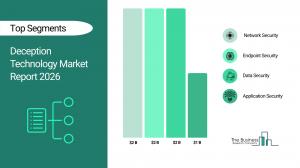
Examined by deception stack, the network security segment is poised to dominate in 2030, representing roughly 33%—or $2 billion—of the total market. This leadership position is driven by deployment of segmented and software-defined network architectures, increasing use of real-time traffic monitoring and anomaly detection, integration of deception traps within internal networks, growth of enterprise-level network visibility platforms, and a sharper focus on detecting lateral movement in complex IT environments. Ongoing improvements in network-centric cyber defense capabilities will keep fueling this segment’s rise.
Various Market Segments by Component, Organization Size, Deployment, and Industry Verticals
On the component side, deception technology is divided into solutions and services. By organization size, the market serves both small and medium enterprises (SMEs) and large enterprises. Deployment options include on-premise and cloud-based models. Industry verticals adopting deception technology span BFSI, energy and utilities, government, healthcare, telecom and IT, manufacturing, retail, and other sectors, demonstrating the technology’s wide-ranging applicability across diverse economic areas.
Steady Market Growth Forecasted with a 16% CAGR Through 2030
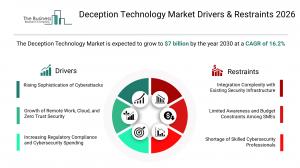
The deception technology market is expected to grow at an annual rate of 16% heading into 2030. This consistent expansion is underpinned by multiple factors tied to evolving cybersecurity needs and accelerating digital transformation initiatives.
Rising Sophistication of Cyberattacks as a Growth Catalyst
A primary driver behind deception technology adoption is the growing complexity and frequency of cyberattacks. Threats including ransomware, zero-day exploits, phishing, insider threats, and advanced persistent threats (APTs) are pushing organizations to implement decoy systems, fake credentials, and trap-based monitoring to catch attackers early. Traditional perimeter defenses are proving less effective, particularly against lateral movements and stealth attacks, making proactive deception strategies more appealing. Sectors such as BFSI, healthcare, telecom, and government—which face targeted cyber threats—are leading the adoption curve. This trend contributes an estimated 2.7% to annual market growth.
The Role of Remote Work, Cloud Expansion, and Zero Trust Security
The rise of hybrid work models, cloud migration, and Zero Trust security frameworks is significantly expanding enterprise attack surfaces. Deception technology addresses this by monitoring distributed users, endpoints, credentials, and cloud workloads through deceptive environments and behavioral detection. Enterprises are increasingly weaving deception tools into Zero Trust architectures to spot unauthorized access and credential misuse in real time. The COVID-19 pandemic accelerated reliance on cloud-native infrastructure and remote access, boosting demand for scalable deception solutions. Vendors are embedding AI-driven deception into cloud and identity security ecosystems, driving roughly 2.5% of annual market growth.
Increasing Regulatory Requirements and Cybersecurity Investments
Stricter regulations and growing cybersecurity budgets are also powering market expansion. Global mandates such as GDPR and CCPA, along with sector-specific compliance requirements, are pushing enterprises to invest in advanced threat detection and monitoring to reduce risks and avoid penalties. Deception technology supports compliance efforts by improving detection speed, cutting breach dwell time, and enhancing monitoring across infrastructures. Rising cyber-insurance demands for proactive threat identification further encourage adoption, contributing around 2.2% to yearly growth.
Key Growth Opportunities Across Core Security Domains
The most promising segments in the deception technology market include application security, data security, endpoint security, and network security. Together, these are expected to generate more than $4 billion by 2030. Growth is driven by rising use of deception-based cybersecurity solutions, demand for proactive threat detection, expansion of automated security operations, deployment of deception layers to mitigate insider threats, and strengthening of enterprise cyber resilience strategies. This emphasis on improving threat detection efficiency and minimizing breach impact is fueling transformative growth across the wider cybersecurity industry.
Projected growth for each security domain from 2025 to 2030 is roughly $1 billion, with the deception technology market comprising a mix of global cybersecurity providers and specialized threat detection firms. Market players are prioritizing advanced deception platforms, automated threat intelligence, adaptive decoy systems, and enhanced security analytics to stay competitive. Key focus areas include proactive detection, real-time monitoring, incident response readiness, and seamless integration with existing security frameworks.
Top Market Leader in Deception Technology
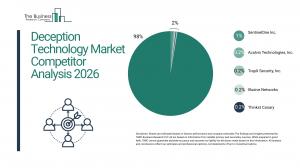
Research indicates that SentinelOne Inc. led global sales in 2025 with a 1% market share. Its cybersecurity solutions division offers a comprehensive suite of endpoint security, threat detection, automated response, and cyber defense tools that support enterprise security operations and proactive risk management.
Prominent Companies Shaping the Deception Technology Market
Notable participants in the deception technology space include SentinelOne Inc., Acalvio Technologies, Inc., TrapX Security, Inc., Illusive Networks, Thinkst Canary, Fortinet, Inc., CounterCraft Security, Darktrace Limited, Fidelis Cybersecurity, Inc., Cymmetria, Inc., Guardicore Ltd., Allure Security Technology, Inc., RevBits LLC, TopSpin Security Ltd., Deceptive Bytes Ltd., CyberTrap Software GmbH, Minerva Labs Ltd., Palo Alto Networks, Lupovis GmbH, and Cynet Ltd.
Market Fragmentation and Competitive Landscape
The market is relatively fragmented, with the top 10 companies collectively accounting for only about 2% of total revenue in 2025. This low concentration reflects ongoing cybersecurity evolution, demand for proactive threat solutions, integration complexities, and the need for continuous innovation in cyber defense. Leading firms maintain market shares through diversified portfolios, advanced detection capabilities, strong enterprise relationships, global distribution, and persistent technology development. As the need for automated threat intelligence, real-time monitoring, and integrated cybersecurity platforms grows, strategic partnerships, innovation, and geographic expansion will further cement competitive positions.
Key Raw Material Providers Supporting the Market
Major suppliers providing foundational technologies and software components for deception technology include Palo Alto Networks Inc., CrowdStrike Holdings Inc., Fortinet Inc., Check Point Software Technologies Ltd., Broadcom Inc., Cisco Systems Inc., IBM Corporation, Microsoft Corporation, VMware Inc., Dell Technologies Inc., Hewlett Packard Enterprise Company, Intel Corporation, NVIDIA Corporation, Qualcomm Incorporated, Broadcom Software Group, Juniper Networks Inc., F5 Inc., Zscaler Inc., Cloudflare Inc., SentinelOne Inc., Sophos Limited, Trend Micro Incorporated, McAfee Enterprise, Kaspersky Lab, and Bitdefender.
Leading Wholesalers and Distributors in the Deception Technology Ecosystem
Key wholesalers and distributors playing a pivotal role in the deception technology supply chain include Ingram Micro Inc., Tech Data Corporation, Arrow Electronics Inc., Avnet Inc., Synnex Corporation, CDW Corporation, Insight Enterprises Inc., SHI International Corp., Softchoice Corporation, Computacenter plc, Bechtle AG, ALSO Holding AG, Exclusive Networks SA, Westcon Group, ScanSource Inc., D&H Distributing Company, Redington Limited, Esprinet S.p.A., Logicom Public Limited, Mindware FZ LLC, EET Group A/S, ASBIS Enterprises PLC, Nuvias Group, TD SYNNEX Corporation, and Synnex West.
Significant End Users Driving Demand for Deception Technology
Major adopters include leading financial institutions such as Bank of America Corporation, JPMorgan Chase & Co., Wells Fargo & Company, Citigroup Inc., HSBC Holdings plc, Barclays plc, Deutsche Bank AG, BNP Paribas S.A., Morgan Stanley, and Goldman Sachs Group Inc. Healthcare providers like Mayo Clinic and Cleveland Clinic, industrial giants Siemens AG and General Electric Company, defense contractors Lockheed Martin Corporation, Northrop Grumman Corporation, Boeing Company, as well as telecom operators Verizon Communications Inc., AT&T Inc., Vodafone Group plc, Orange S.A., Deutsche Telekom AG, and automotive manufacturers Toyota Motor Corporation and Airbus SE are also key end users. Consulting firm Accenture plc rounds out the list of significant market participants.
Notable Competitive Trends Shaping Market Dynamics
Artificial intelligence-driven cyber deception platforms are reshaping the deception technology market by enabling earlier threat detection, disrupting automated attacks, and strengthening cyber defense measures. For example, in March 2026, Acalvio Technologies introduced 360 Deception, an AI-powered platform designed to counter AI-based attack automation. Its use of dynamic decoys, honeytokens, and deceptive environments allows for faster threat identification and reduced impact from intrusions, improving protection against evolving cyber risks.
Strategies Companies Employ to Maintain Market Leadership
Market-leading companies are enhancing their deception technology offerings by developing adaptive decoy environments that improve threat visibility and intelligence. They are also expanding their cyber defense infrastructures to strengthen protection and mitigate risks. Integration of AI deception solutions is becoming a focus to boost automation and accelerate threat identification, supporting more effective and efficient cybersecurity operations.
In summary, the deception technology market is poised for robust expansion driven by growing cybersecurity challenges, technological innovation, and increasing regulatory demands. With Asia-Pacific and the United States leading regionally, and network security as the largest segment, ongoing advances in AI and integration with broader security frameworks will continue to shape this vital segment of the cybersecurity industry through 2030.
New additions to our 2026 reports:
• Market attractiveness scoring and analysis
• Total addressable market (TAM) analysis
• Company scoring matrix graphics and tables
• Excel-based forecasting dashboards
• Market hotspots infographics
• Key technologies and future trend analysis
• Updated graphics and tables
Learn More About The Business Research Company
The Business Research Company (www.thebusinessresearchcompany.com) is a leading market intelligence firm renowned for its expertise in company, market, and consumer research. We have published over 30,000+ reports across 27 industries and 60+ geographies. Our research is powered by 1,500,000 datasets, extensive secondary research, and exclusive insights from interviews with industry leaders.
We provide continuous and custom research services, offering a range of specialized packages tailored to your needs, including Market Entry Research Package, Competitor Tracking Package, Supplier & Distributor Package and much more.
Disclaimer: Please note that the findings, conclusions and recommendations that TBRC Business Research Pvt Ltd delivers are based on information gathered in good faith from both primary and secondary sources, whose accuracy we are not always in a position to guarantee. As such TBRC Business Research Pvt Ltd can accept no liability whatever for actions taken based on any information that may subsequently prove to be incorrect. Analysis and findings included in TBRC reports and presentations are our estimates, opinions and are not intended as statements of fact or investment guidance.
Contact Us:
The Business Research Company
Americas +1 310-496-7795
Europe +44 7882 955267
Asia & Others +44 7882 955267 & +91 8897263534
Email: marketing@tbrc.info
Follow Us On:
LinkedIn: https://in.linkedin.com/company/the-business-research-company
Oliver Guirdham
The Business Research Company
+44 7882 955267
info@tbrc.info
Visit us on social media:
LinkedIn
Facebook
X
Why it matters: As cyberattacks grow more sophisticated and traditional defenses struggle against lateral movement and stealth tactics, deception technology offers a proactive layer that can catch threats early. With projections showing the market nearly tripling by 2030 and Asia-Pacific emerging as the growth leader, enterprises and security vendors alike should watch this space closely for investment and adoption opportunities.