The Business Research Company’s latest forecast reveals a striking trajectory for the artificial intelligence synthetic data sector: what was a niche subset of the tech industry is poised to become a multi-billion-dollar market within the next few years. The projections, detailed in the firm’s Artificial Intelligence (AI) in Synthetic Data Global Market Report 2026 – Market Size, Trends, And Forecast 2026-2035, point to explosive growth driven by privacy concerns and the insatiable demand for AI training data.
LONDON, GREATER LONDON, UNITED KINGDOM, October 26, 2026 /EINPresswire.com/ — The market for AI-generated synthetic data is accelerating at a remarkable pace, fueled by advances in machine learning and a growing corporate need for datasets that don’t compromise user privacy. As artificial intelligence becomes embedded in everyday business operations, synthetic data—algorithmically generated information that mimics real-world patterns—is emerging as a foundational tool for safer and more efficient model development.
According to the Artificial Intelligence in Synthetic Data Market Report, the sector is expected to surpass $9 billion by 2030. While that figure may seem modest when placed against the broader Information Technology industry—projected at $13,788 billion in the same year—it represents roughly 0.1% of that massive ecosystem and signals the segment’s growing relevance. The jump from $0.7 billion in 2025 to $9.35 billion reflects a compound annual growth rate of 37%.
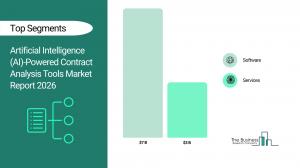
Also worth a look: CCPA Purchasing Partners gives independent doctors a 22% edge on vaccine costs and The Business Research Company projects AI contract tools hitting $10B by 2030, led by software.
North America is forecast to be the dominant region, with market value reaching $3.2 billion by 2030. The United States alone is expected to contribute $2.8 billion of that total, up sharply from $0.6 billion in 2025. The region’s leadership is attributed to widespread enterprise adoption of generative AI, heavy investment in cloud infrastructure, and the presence of leading AI research institutions. Regulated sectors like healthcare, finance, and defense are also turning to synthetic data to navigate compliance hurdles.
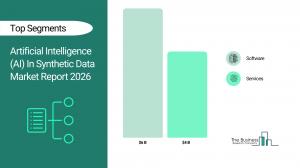
Software is projected to capture the largest market share at 59%, or roughly $6 billion, driven by demand for automated data creation platforms and tools that integrate seamlessly into enterprise AI pipelines. The market is further segmented by data type—tabular, image, text, and video—and by application, including data augmentation, model training, privacy protection, and fraud detection.
End-user industries span government, IT and telecommunications, retail, automotive, healthcare, and banking and financial services. These sectors are increasingly reliant on synthetic datasets to fuel AI development without exposing sensitive information. The growth is not uniform, though; the report identifies several key drivers, including the rapid adoption of generative AI, which alone is expected to contribute 1.5% to annual growth, and the rising emphasis on privacy-preserving data solutions, adding roughly 1.0% per year. The need for high-quality, well-labeled training data—particularly for edge cases and rare events—adds another 0.8% annually.
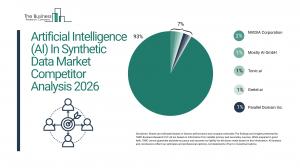
NVIDIA Corporation leads the competitive landscape with a 2% share of global sales in 2025. The company’s portfolio spans GPU-accelerated computing, simulation platforms, and generative AI frameworks. Other notable players include Mostly AI GmbH, Tonic.ai, Gretel.ai, Parallel Domain Inc., Datagen Technologies Inc., and Synthesis AI Inc. The market remains highly fragmented, with the top ten firms controlling just 7% of total revenue. A notable strategic move came in March 2025, when NVIDIA acquired Gretel, a synthetic data platform provider, to bolster its generative AI ecosystem and improve large language model training capabilities.
The supply chain is supported by major technology providers such as Advanced Micro Devices, Intel, Amazon Web Services, Microsoft Azure, and Google Cloud, which supply the hardware and infrastructure necessary for synthetic data generation. Distribution networks rely on companies like TD SYNNEX, Ingram Micro, and Arrow Electronics. Prominent end users include Tesla, Waymo, BMW, Siemens, Pfizer, JPMorgan Chase, Mastercard, Airbus, Walmart, Amazon, and OpenAI, among others.
Looking ahead, the combined software and services segments are expected to add more than $7 billion in market value by 2030. The report also introduces new analytical tools, including market attractiveness scoring, total addressable market analysis, and company scoring matrices. The Business Research Company, which has published over 30,000 reports across 27 industries, emphasizes that its findings are estimates based on information gathered from primary and secondary sources and should not be construed as investment guidance.
Why it matters: The rapid expansion of synthetic data signals a fundamental shift in how organizations approach AI development—prioritizing privacy, scalability, and bias reduction over raw data collection. As regulatory scrutiny intensifies and the limits of real-world data become apparent, synthetic data could become the standard for training the next generation of AI systems. The market’s growth also underscores the increasing interdependence between hardware suppliers, software platforms, and end users across industries.