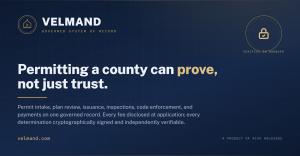
This secure, multi-tenant govtech platform consolidates permit intake, plan review, issuance, inspections, code enforcement, and payments onto a single governed record.
VELMAND lets a building department prove its record instead of asking the public to trust it: every fee disclosed at application, every determination cryptographically signed.”— Angela Irizarry, Founder and AI Systems ArchitectLARGO, FL, UNITED STATES, August 29, 2026 /EINPresswire.com/ — AIVG Holdings has announced the general release of VELMAND, a secure, multi-tenant software platform designed for state and local building departments. The platform brings together permit intake, plan review, issuance, inspections, code enforcement, and payments on a single governed record, and is built so that every calculated fee and every decision it makes can be independently verified.
Older permitting systems break a project apart across separate trade permits, delay fees until approval, and require both applicants and officials to trust numbers they cannot verify. VELMAND adopts a contrasting method: complete cost visibility at intake, rule-based review aligned with each jurisdiction's current code edition, and a record system where integrity can be demonstrated instead of merely claimed.
Primary features include:
1) Upfront fee visibility at submission. All relevant fees, including impact fees, are calculated and revealed at the time an application is filed, rather than postponed until approval.
2) Automated pre-review of plans. Every submission is assessed against the county's presently adopted code version, referencing the exact section relative to the measured value, before a reviewer opens the document.
3) Cryptographically verifiable records. Each significant decision receives an Ed25519 signature and is embedded into a tamper-evident, hash-linked ledger. VELMAND provides a live cryptographic self-check: the sample determination at velmand.com is validated against VELMAND's publicly listed key within the visitor's own browser, and any modified record will not pass the verification.
4) Single project record. A construction project is treated as one entity instead of multiple permits that block each other, with dependent permits