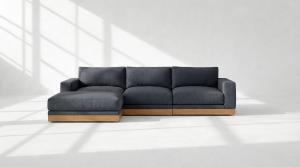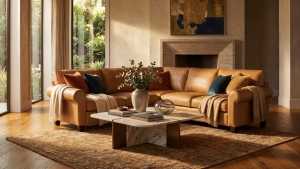
BEVERLY HILLS, CA, UNITED STATES, September 6, 2026 /EINPresswire.com/ — According to DreamSofa, a manufacturer of direct-to-consumer custom furniture, an increasing share of its order consultations now includes specifications linked to home-based work. The company has also issued buying guidance for customers whose primary living-room seating doubles as a workplace during part of the day.
Continued findings from federal labor statistics and workplace surveys show that a significant percentage of American knowledge workers still telecommute for either part or all of the week. The initial wave of this change led to a documented uptick in demand for task chairs and desks. DreamSofa notes that the effect on upholstered living-room seating took longer to emerge but is now evident in how buyers articulate their needs when placing orders: laptop comfort, posture over extended durations, video-call backgrounds, and household members using the sofa instead of a desk.
The firm states that before 2020, such language was largely absent from its consultations.
"Nobody set out to redesign the living room," said a DreamSofa spokesperson. "The workday moved into it gradually. What has changed more recently is that buyers name it when they order, rather than treating it as a temporary arrangement."
How work use changes seating specification
Extended seated work imposes different demands on a sofa compared to evening relaxation, and DreamSofa says those differences correspond to specific construction choices that can be specified.
Cushion firmness and resilience affect posture during long periods. Seat cores with higher resiliency resist the gradual slouch that soft lounge cushions allow over a multi-hour session, and back cushions with added internal structure support an upright rather than a reclined position.
Seat depth runs counter to current lounge trends. A shallower seat enables a working posture with feet on the floor and the lower back touching the backrest. Deeper seats, commonly chosen for lounging, force the sitter either to lean forward without back support or to recline further than is practical for typing.
Arm height and width become functional rather than merely decorative, as arms are used to support forearms while using a laptop and to hold a laptop tray or cup.
The company notes that none of these preferences is unusual in isolation. What is new is that buyers specify them at the time of purchase. DreamSofa says modular orders with mixed specifications — a firmer section within an otherwise softer sectional — have become a frequent way for households to meet a work requirement without altering seating for everyone else.
Layout, zoning and camera sightlines
Home working has also influenced where furniture is placed. Video calls make living rooms visible to colleagues, and DreamSofa reports that a subset of buyers now arranges seating around camera sightlines, either orienting a sofa to create a usable background or using modular sections and open-backed configurations to separate a work zone from a living area without partitions.
The firm describes this as a residential version of a practice already common among architects and designers, who employ modular seating to define zones within open floor plans. In apartments where a single room functions as an office during the day and a living room at night, a reconfigurable system can be rearranged between weekday and weekend layouts, or altered when a household's work pattern changes.
Use hours and durability
DreamSofa says the less visible consequence is arithmetic. A sofa in a household with two commuters might see three or four hours of daily use, mostly in the evening. The same sofa in a household where someone works from home can see eight to twelve hours, as work hours are added to leisure hours.
That increase translates into more compression cycles on cushion cores, more load cycles on frames and suspension, and more abrasion on fabric surfaces. DreamSofa says this rise is enough to shorten the service life of lower-specification seating considerably, and that it directs buyers in this situation toward the same specifications it recommends for multigenerational and pet-owning households: high-resiliency cushion cores, fabrics with high double-rub abrasion ratings, and kiln-dried hardwood frame construction.
"The use profile of a sofa in a home-working household has more in common with commercial seating than with residential seating as it was specified twenty years ago," the spokesperson said. "That is a construction question before it is a comfort question."
Buying behavior
DreamSofa says the pattern it observes is consistent with households viewing home working as a permanent rather than temporary arrangement. Instead of improvising with lap desks while waiting for a full return to offices, buyers are specifying primary furniture for dual use at the point of purchase.
The company connects this to a shift recorded in its 2026 Mid-Year Consumer Insights Report, where buyers reported evaluating furniture on cost per year of use rather than solely on purchase price.
Stated limits
DreamSofa is clear about the scope of the guidance. Ergonomics literature consistently indicates that sustained, focused desk work is best done at a properly configured workstation, and the firm says it informs customers that no sofa specification can replace a task chair for a full eight-hour working day.
The guidance addresses the portion of the workday that does not take place at a desk — reading, calls, review work, the hour before dinner — and households where a dedicated office does not exist. Supporting an upright posture for ninety minutes is a different engineering target from supporting one for eight hours.
The company pairs its specification guidance with posture recommendations: feet flat on the floor, the laptop raised on an arm or tray rather than resting directly on the lap, and a change of position each hour.
About DreamSofa
DreamSofa is a direct-to-consumer custom furniture manufacturer specializing in made-to-order sofas, sectionals, modular seating systems, and sleeper sofas built on kiln-dried hardwood frames. Seat firmness, depth, height, and configuration are specified per order through its FlexForm Sizing system. Every piece is backed by a lifetime frame warranty and a 100-day home trial. More information is available at www.DreamSofa.com.
Remote and hybrid work prevalence referenced above reflects publicly reported workplace surveys and federal labor statistics. Ergonomics guidance referenced reflects standard published recommendations. Remaining statements describe DreamSofa's own products, specifications, and customer observations
Maria Gonzalez
MGP
+1 305-204-8988
email us here