When a molecule cannot cross biological barriers, its therapeutic promise often stalls before it ever reaches the bloodstream. That is why new ex-vivo data from Trait Biosciences stands out: its water-soluble cannabinoid candidate, CBD82S™, moved through skin and intestinal membranes at levels dramatically higher than conventional CBD, signaling a potential shift in how cannabinoid drugs could be delivered.
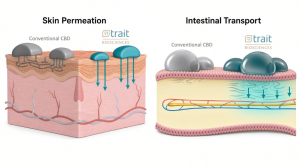
Ex-vivo studies show CBD82S™ achieved over 100-fold greater skin permeation and enhanced intestinal membrane transport compared with conventional CBD.
CBD82S™ demonstrated substantially greater membrane permeation than conventional CBD in ex-vivo models, supporting further research of its potential for pharmaceutical drug delivery.— Hanny Kanafani, President & COO, Trait Biosciences
SANTA FE, NM, UNITED STATES, October 21, 2026 /EINPresswire.com/ — In head-to-head laboratory comparisons, Trait Biosciences’ CBD82S™ outperformed conventional CBD by a wide margin in crossing the skin and intestinal membranes in ex-vivo models. The findings offer a clearer picture of how water-soluble cannabinoid molecules interact with biological barriers, a critical step for any compound intended for pharmaceutical use.
Membrane permeation is a fundamental measure when assessing how an active compound might be delivered and whether it can reach its target site. This is especially relevant for CBD, which is naturally lipophilic and poorly soluble in water—a combination that has long complicated formulation and absorption efforts.
In the company’s studies, CBD82S™ crossed the tested membranes at substantially higher levels than conventional CBD under identical conditions. Notably, the research does not yet identify the molecular mechanism behind this difference, and further investigation is required to determine exactly how CBD82S™ navigates biological barriers.
Enhanced Membrane Permeation
The ex-vivo results showed CBD82S™ achieved markedly greater permeation and transport across biological membranes compared with conventional CBD. Key findings included:
- Over 100-fold greater skin permeation under the conditions tested
- Enhanced transport across the intestinal membrane
These outcomes indicate that CBD82S™ behaved distinctly from conventional CBD in the membrane models evaluated, pointing to physicochemical properties that may be relevant for drug development.
Why Membrane Permeation Matters
Biological barriers often determine whether an active compound ever reaches its intended environment. For oral delivery, transport across the intestinal membrane is one factor in moving from the gastrointestinal tract toward systemic circulation. For topical applications, skin permeation is essential for delivering the compound into relevant skin layers.
Demonstrating membrane permeation is thus an important early step in evaluating a compound’s delivery characteristics. While crossing a biological barrier may make a compound available for subsequent interaction with biological systems, permeation alone does not prove absorption, biological activity, or clinical efficacy.
Skin Permeation
The skin is a notoriously difficult barrier for active compounds to penetrate. In the ex-vivo model tested, CBD82S™ showed over 100-fold greater permeation through the skin compared with conventional CBD under the same conditions.
That result supports further investigation of CBD82S™ for applications where delivery into or across the skin is a key consideration, though additional studies are needed to determine how these ex-vivo findings translate to real-world formulations and biological outcomes.
Intestinal Membrane Transport
For oral medications, the intestinal membrane is a major hurdle to absorption. In the ex-vivo studies, CBD82S™ demonstrated enhanced transport across the intestinal membrane relative to conventional CBD.
These findings add to the understanding of CBD82S™’s transport characteristics and support continued research into its potential role in oral cannabinoid delivery. Still, ex-vivo membrane transport is not a direct measure of human oral bioavailability. Trait Biosciences is continuing studies to evaluate absorption, systemic exposure, and pharmacokinetic performance.
What the Findings Mean for Cannabinoid Development
CBD’s lipophilic, water-insoluble nature has long created formulation and delivery challenges, especially in aqueous environments. CBD82S™ was developed through Trait Biosciences’ proprietary technology platform to offer a water-soluble cannabinoid molecule with distinct physicochemical properties.
The observed differences in membrane permeation and transport provide a foundation for investigating how these properties might influence cannabinoid delivery. For development programs, membrane behavior is just one consideration alongside formulation, absorption, metabolic stability, bioavailability, and pharmacokinetics. The current ex-vivo findings do not establish that water solubility alone explains the observed differences, nor do they clarify the molecular mechanism of membrane transport or predict clinical outcomes.
Looking Ahead
These membrane findings build on Trait Biosciences’ broader research into CBD82S™. In a human liver microsome model, CBD82S™ demonstrated an approximately 25-fold longer apparent half-life than conventional CBD under the conditions evaluated.
Together, these studies offer experimental insight into how CBD82S™ behaves across different biological models. Further research will aim to uncover the mechanisms behind the observed membrane behavior and determine how these permeation and transport findings translate to in-vivo absorption, tissue exposure, systemic exposure, and overall pharmacokinetic performance.
For additional information on the study, including study design, methodology, and detailed findings, please contact Trait Biosciences at info@traitbio.com.
Why it matters: If CBD82S™’s membrane-crossing advantage holds up in human studies, it could help overcome the bioavailability hurdles that have limited CBD-based therapeutics for years. The combination of enhanced permeation and a longer apparent half-life positions this compound as a candidate worth watching in cannabinoid drug development.
Thu Dang
Trait Biosciences Inc.
+1 626-200-5348
Visit us on social media:
LinkedIn
YouTube