
If you think the chip shortage was a big story, consider what’s happening behind the scenes in the factories that make those chips. The specialized machines that carve microscopic circuits into silicon wafers are about to see a serious boom — and the explosive growth of electric vehicles is a major reason why.
The Business Research Company’s Chemical Dry Etching Equipment Global Market Report 2026 – Market Size, Trends, And Forecast 2026-2035
Recent advances in semiconductor technology and a hunger for ever-more-sophisticated consumer electronics are pushing the chemical dry etching equipment market into a new phase of growth. This report breaks down the current size of the market, the forces shaping it, regional trends, and what lies ahead for this niche but critical piece of manufacturing hardware.
Market Size and Growth Outlook
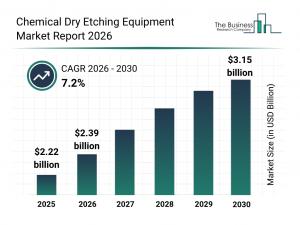
The market for chemical dry etching equipment has already been on a strong run. Valued at $2.22 billion in 2025, it is forecast to climb to $2.39 billion in 2026 — a compound annual growth rate (CAGR) of 7.6%. That momentum, analysts say, comes from expanded semiconductor manufacturing, a surge in demand for cutting-edge gadgets, increased production of miniaturized chip parts, the growing use of high-density integrated circuits, and a greater need for precise wafer pattern transfer techniques.
Looking further ahead, the market is expected to keep expanding at a robust clip, hitting $3.15 billion by 2030 at a CAGR of 7.2%. Driving that future growth: rising requirements for advanced semiconductor nodes, a boom in high-performance computing chips, growing demand for compound semiconductor devices, the push for ever-finer circuit geometries, and increased investment in new semiconductor fabrication plants. Key trends shaping the forecast period include wider adoption of high-precision dry etching methods, a greater focus on etching uniformity, increased use of selective etching processes, demand for low-damage substrate handling, and the rise of advanced etching process control technologies.
Download a free sample of the chemical dry etching equipment market report:
https://www.thebusinessresearchcompany.com/sample_request?id=16380137&type=smp&name=Chemical%20Dry%20Etching%20Equipment%20Market%20Report%202026&utm_source=EINPresswire&utm_medium=Paid&utm_campaign=Oct_PR
What Is Chemical Dry Etching Equipment?
At its core, chemical dry etching equipment is a family of sophisticated manufacturing systems that selectively remove material from semiconductor wafers, printed circuit boards (PCBs), and other substrates. Instead of liquid chemicals, these machines use reactive gases or plasma to carve away material. They are essential for transferring intricate patterns in microelectronics production with high precision, forming extremely fine circuit features with outstanding accuracy, uniformity, and minimal damage to substrates — making them indispensable for fabricating state-of-the-art semiconductor and electronic devices.
Why the Market Is Growing: The Electric Vehicle Factor
One of the most powerful forces behind the chemical dry etching equipment market’s expansion is the rapid growth of automotive electronics and electric vehicles (EVs). Automotive electronics — the electronic components and systems that improve vehicle performance, safety, connectivity, and energy efficiency — are becoming more sophisticated by the year. Electric vehicles, in particular, rely heavily on advanced electronic modules.
The rising need for advanced safety features, better connectivity, and energy-saving technologies in modern cars is driving this trend. As vehicles become more dependent on complex electronic systems — to boost performance, lower emissions, and improve the user experience — the demand for precise semiconductor device manufacturing increases. This includes devices such as sensors, power electronics, and microelectromechanical systems (MEMS) used in advanced driver assistance systems, battery management systems, electric powertrains, and other in-vehicle electronics. For example, in January 2024, Kelley Blue Book, a U.S.-based company under Cox Automotive, reported that in 2023 a record 1.2 million car buyers in the United States opted for electric vehicles, making up 7.6% of the total vehicle market, up from 5.9% in 2022. That surge in EV adoption is directly supporting the chemical dry etching equipment market’s expansion.
View the full chemical dry etching equipment market report:
https://www.thebusinessresearchcompany.com/report/chemical-dry-etching-equipment-market-report?utm_source=EINPresswire&utm_medium=Paid&utm_campaign=Oct_PR
Regional Dynamics
In 2025, the Asia-Pacific region held the largest share of the chemical dry etching equipment market. And it is not just the biggest player today — it is also expected to be the fastest-growing region throughout the forecast period. The market report provides comprehensive coverage of key regions including Asia-Pacific, South East Asia, Western Europe, Eastern Europe, North America, South America, the Middle East, and Africa, offering a broad view of global market dynamics and regional growth potential.
Our 2026 market reports now include enhanced strategic insights through:
- Market attractiveness scoring and analysis
- Total addressable market (TAM) analysis
- Company scoring matrix graphics and tables
- Excel-based forecasting dashboards
- Market hotspots infographics
- Key technologies and future trend analysis
- Updated graphics and tables
Speak With Our Expert:
Saumya Sahay
Americas +1 310-496-7795
Asia +44 7882 955267 & +91 8897263534
Europe +44 7882 955267
Email: marketing@tbrc.info
The Business Research Company – www.thebusinessresearchcompany.com
Follow Us On:
• LinkedIn: https://in.linkedin.com/company/the-business-research-company
Oliver Guirdham
The Business Research Company
+44 7882 955267
info@tbrc.info
Visit us on social media:
LinkedIn
Facebook
X
Why it matters: The growth of the chemical dry etching equipment market is a direct indicator of how deeply semiconductors are embedded in the future of transportation and computing. As EVs and advanced electronics become the norm, the machines that make their tiny, powerful chips will be in higher demand — making this market a bellwether for broader technological and economic shifts.