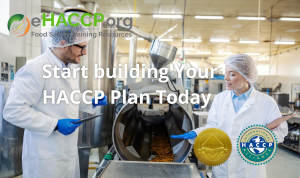
eHACCP.org provides HACCP instruction that both gives an IHA-recognized Certificate of Completion and truly shows participants how to construct a HACCP plan.
I really enjoyed the training module’s design. The platform is straightforward to use and navigate. The support team is excellent and replies fast when needed. I would strongly recommend it!”— Jason AllsLUNENBURG, NS, CANADA, September 4, 2026 /EINPresswire.com/ — eHACCP.org, a top provider of online HACCP training and certification, delivers a range of sector-specific HACCO courses focused on teaching HACCP plan creation.
Most companies understand they require a food safety plan. Some only discover this after starting production, when a client or inspector points it out. Few have any idea where to begin, who will develop it, how long it will take, what it will cost, or who needs to approve it.
As a prominent IHA-accredited HACCP training and certification provider, eHACCP.org offers online HACCP and food safety education that is uniform, verifiable, budget-friendly, and considerably more hands-on than bringing in a consultant to stare at an empty flowchart. The program does more than hand out a certificate; it shows learners how to develop the plan step by step.
The eHACCP.org courses start with the basics of HACCP: its history, how HACCP and HARPC intersect under FDA’s FSMA, at-risk populations, and the four hazard categories—biological, physical, chemical, and radiological. Participants then go through the Prerequisite Programs (PRPs) outlined in 21 CFR Part 117, which include Current Good Manufacturing Practices (cGMPs):
• Sanitation and cleaning procedures
• Pest control
• Personal hygiene and employee training
• Facility design and maintenance
• Supplier approval and raw material control
• Allergen management
The opening five HACCP steps are explored thoroughly using real-life examples, such as assembling the appropriate HACCP team, identifying the product and its end users, creating a process flow diagram, and confirming its accuracy on the production floor—not just on paper. The remaining seven steps are the core principles, presented in a logical order:
Principle 1 – Hazard Analysis: Recognizing every biological, physical, chemical, and radiological risk in the process before any CCP is identified.
Principle 2 – Critical Control Point Identification: A CCP is a precise, measurable step where a targeted control is required to avoid or eliminate a major food safety hazard, and distinguishing a CCP from a general control measure is mandatory.
Principle 3 – Establishing Critical Limits: Setting fixed, quantifiable criteria—exact time, temperature, pH, and metal detector settings—leaving no room for interpretation or guesswork.
Principle 4 – Monitoring Procedures: Introducing continuous observation, since unexpected factors can cause even the best controls to fail without notice.
Principle 5 – Corrective Actions: Knowing precisely what to do when a critical limit is exceeded—fix the issue, safely handle the affected product, and document everything so it does not become a recurring problem.
Principle 6 – Verification Procedures: Using tests, reviews, and audits to confirm that the system is effective, not just in the binder but on the actual production line.
Principle 7 – Record-Keeping and Documentation: Keeping clear, written records of the hazard analysis, monitoring results, and corrective actions—the evidence that auditors and regulators expect before they ask for it.
To assist at every stage, eHACCP.org supplies more than 250 downloadable, customizable templates for GMPs, SSOPs, SOPs, logs, charts, and tables. The heavy work is already completed; learners simply open, edit, and personalize them. eHACCP.org offers a toll-free support line for live customer assistance. The company holds a 4.9-star rating based on over 1000 reviews.
Stephen Sockett
eHACCP.org
+1 902-343-7763
email us here