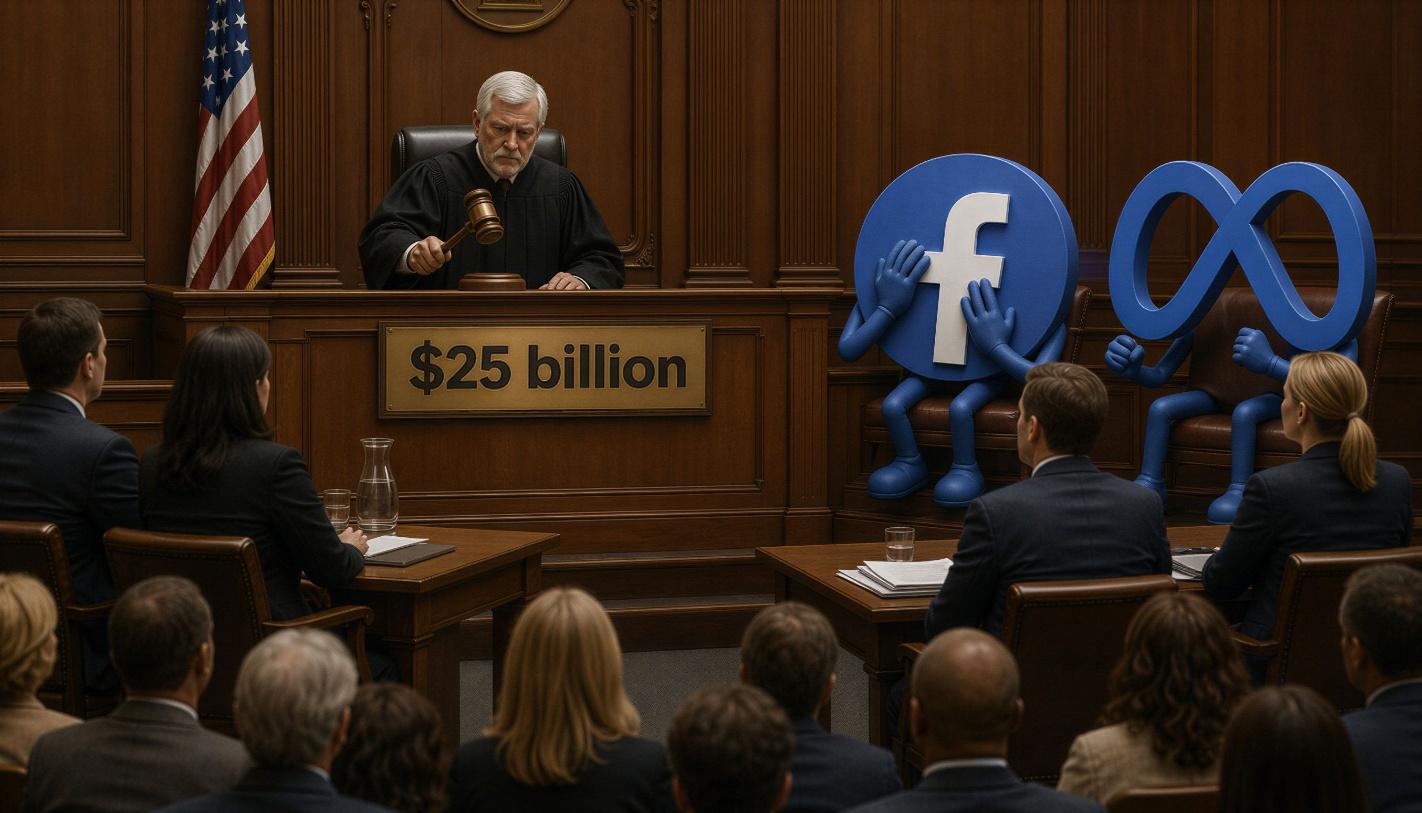
For years, those who have documented Meta’s abuses have been told that the company is too big to discipline. That argument took a serious blow on October 21, 2026, when a New Mexico judge ordered Meta to pay $25 billion for deceiving users about its privacy practices — the biggest fine ever imposed on the owner of Facebook.
As described by multiple news sources, the case grew out of the Cambridge Analytica scandal, in which a third-party quiz app harvested the personal data of as many as 87 million Facebook users without their consent. New Mexico’s attorney general sued Meta in 2021, arguing the company had misled the public about how it safeguarded user data. After a two-week trial, a jury in Santa Fe found in September that Meta had committed more than 43 million violations of New Mexico’s consumer protection law, with each violation carrying a penalty of up to $5,000. Judge Francis Mathew calculated that the law entitled the state to roughly $219.5 billion, then reduced the figure to $25 billion, with 15% annual interest accruing until it is paid in full. The jury found that 26 of 29 statements the company and its leadership made about privacy and content moderation were false or deceptive.
As might be expected, Meta says it will appeal. Its chief legal officer, C.J. Mahoney, said the ruling and the attorney general’s enforcement approach made it “all but impossible to do business in the state of New Mexico” and that the company is “confident we will prevail on appeal”. So the outcome is not final. Even so, the verdict reflects what a jury of ordinary citizens, and now a judge, concluded: that Meta’s deception was not a series of accidents. It was the business model.
A Pattern, Not an Accident
In his ruling, Judge Mathew wrote that Facebook’s misrepresentations about users’ control of their data were “not isolated incidents, but rather a systematic pattern of deception at the core of Facebook’s business model”. He wrote that the company’s wrongdoing “goes to the heart of Facebook’s core business practices”, and the jury found that Meta’s most senior leadership — including Mark Zuckerberg and former COO Sheryl Sandberg — made misrepresentations about the service’s data privacy practices.
This verdict does not stand alone. It lands on top of a long list of judgments and settlements, which include the following:
- The FTC’s $5 billion penalty in 2019, which was imposed after the Federal Trade Commission found Facebook deceived users about their ability to control their personal data, at the time the largest privacy penalty in U.S. history.
- The $725 million settlement of the Cambridge Analytica user privacy class action.
- The $650 million settlement of the Illinois lawsuit alleging that Facebook’s facial recognition “tag suggestions” built a faceprint database without users’ consent, in violation of that state’s biometric privacy law.
- The $1.4 billion settlement with Texas resolving similar allegations of unlawful biometric harvesting; Meta did not admit wrongdoing as part of that deal.
- The record €1.2 billion (about $1.3 billion) European Union fine in 2023 for illegally transferring European users’ data to the United States.
And 2026 alone has been a punishing year for Meta in court. In March, a New Mexico jury found Meta liable for misleading users about the safety of its platforms for children, imposing a $375 million penalty, and a judge later ordered an additional $567 million payment into a youth mental health fund — bringing Meta’s bill in that one case to more than $940 million, though as is often the case, Meta is appealing. The same month, a Los Angeles jury found Meta and Google negligent for designing addictive platforms that harmed a young woman’s mental health, awarding her $6 million, with Meta bearing 70% of the responsibility; Meta is appealing that verdict as well. In August, Meta agreed to pay up to $18 billion to settle youth-harm claims brought by dozens of states, alongside new child-safety measures on Facebook and Instagram. And a federal appeals court dismissed the companies’ premature appeal for lack of appellate jurisdiction, allowing thousands of social media addiction lawsuits to continue without deciding whether Section 230 ultimately defeats the claims.
New Mexico’s attorney general, Raúl Torrez, called the $25 billion judgment “one of the largest, if not the single largest state verdict against a company in American history”. These proceedings involve different conduct, different legal theories, and different outcomes. Some judgments are being appealed; settlements resolve specified claims but are not trial findings of wrongdoing. Taken together, they strengthen the argument for clear, enforceable national protections against Meta and Facebook, rather than relying entirely on case-by-case litigation, one state at a time.
The Wrongs That Never Made Headlines
I have written about these issues in my books “What’s Wrong with Facebook” and the “Problem with Facebook” series, and in my ongoing Campaign Against Facebook and Meta. What the big verdicts miss is the quieter, everyday damage — the harms that rarely reach a jury because individual users have no realistic path to sue a giant corporation.
Consider the problems the letter-writing campaign seeks to address:
- The “selfie verification” trap. When an account is compromised, Facebook often demands a selfie or video to “verify” identity — and its automated system can fail legitimate users repeatedly. I know this firsthand: when my own account was hacked and the password changed, I failed Facebook’s selfie verification test a dozen times. The campaign seeks workable identity verification and a human appeal, not an automated dead end.
- Terminations without explanation. The campaign seeks meaningful explanations and timely appeals for account suspensions and deletions. For small businesses, creators, and community organizations, losing an account without a stated reason is a digital death penalty imposed without trial.
- Ad campaigns cut off — and creators left unpaid. The campaign calls for transparent advertiser-refund procedures when campaigns are shut down for claimed “violations,” and independent review of disputed creator earnings, since often when a campaign is shut down the advertiser doesn’t get their money. That happened to one of my business associates. These are two different kinds of disputes, and both deserve itemized explanations and a real appeal.
- Scam ads and advertising abuses. The campaign also calls for stronger ad verification and accountability for the scam ads — celebrity-face investment schemes and the like — that have long circulated on the platform. But Facebook has left them up and just charged advertisers a little more, turning scam ads into another source of income.
- Addictive design targeting teens. The 2026 verdicts gave new weight to what critics have long complained about — features like infinite scroll and algorithmic recommendations that have kept young users hooked, and juries have found Meta liable for the resulting harm.
- Privacy violations. And always, underneath everything, there is Meta’s misuse of personal data — the wrong at the center of the FTC case, the Illinois and Texas cases, the EU case, and now the largest penalty in Meta’s history.
This pattern of user and advertiser abuse connects the mega-verdicts and the small miseries: in both, Meta treats people as raw material. Their data, their attention, and their time are all extracted, monetized, and when problems arise, consumers are too often ignored or mistreated without recourse.
What Congress Should Do
Here is the hard truth: even $25 billion may not change Meta’s behavior, because litigation is slow, penalties get appealed, and settlements can be priced in as a cost of doing business. What changes behavior is law — clear rules, applied in advance, with enforcement that does not depend on one state attorney general being willing to take the company to trial.
Congress can establish a nationwide baseline of protections, alongside the state laws that have done so much of the work so far. That is what legislation should require:
- Real limits on data collection and use. There should be data minimization rules that prohibit collecting more data on a user than a service actually needs. The law should also prohibit third-party harvesting like Cambridge Analytica by design, and give users genuine, one-click control over their information.
- Biometric consent standards. There should be a national standard requiring explicit, informed consent before any facial recognition or biometric processing, so that protecting your faceprint does not depend on which state you live in.
- Due process for account holders. When a platform terminates an account, it should be required to state the reason, provide evidence, and offer a timely human appeal. There should be no more selfie-verification purgatory, since the program often doesn’t work.
- Transparency in advertising and payments. Advertisers and creators deserve itemized explanations when their campaigns are killed or payouts are withheld, with independent dispute resolution.
- Youth protections with teeth. There should be design standards limiting addictive features for minors, independent audits, and researcher access to platform data with federal legislation that sets the standard for every state, which is what New Mexico had to win in court.
- An end to liability loopholes. Congress should clarify the reach of Section 230 so that hosting third-party speech is protected, while negligent product design is not. Meta has invoked the provision as a defense in the addiction cases; whether that defense ultimately holds is for the courts, which is precisely why the statute’s scope needs legislative attention.
Why Your Letter to Congress Matters Now
This is where the letter-writing campaign comes in — and why it matters more now than ever. Some people assume contacting Congress is a pointless gesture. It doesn’t have to be. Congressional offices track the mail they receive, and letters on the same topic from constituents are one of the practical signals they watch. The verdicts have given letter writers a strong new argument: “Even New Mexico’s courts had to do your job — pass the law.”
Writing an effective letter is simple:
- Write to your own member of the House and both of your senators. If one of them serves on a relevant committee, such as Small Business, Energy and Commerce, Judiciary, or Commerce, that gives you a natural opening to raise the issue with them.
- Keep it short and personal. Write just one page. Lead with the news that a judge just fined Meta $25 billion for a “systematic pattern of deception”. Then tell your own story or one of a friend, family member or business associate. Tell them about the locked account, the killed ad campaign, the withheld payout, the teen in your family who can’t put the phone down, or other problem with Facebook or Meta.
- Ask for something specific. For example, you might write a letter that includes the following approach.
As your constituent, I urge you to support enforceable privacy and youth-safety protections for social media users, meaningful reasons and appeals before platforms terminate accounts, and transparent advertising and payment dispute procedures. I am writing to you because (THEN ADD IN A PARAGRAPH DESCRIBING YOUR REASONS AND ANY PERSONAL EXPERIENCES).
I hope you will help support this effort to regulate Facebook and Meta. Please let me know what legislation or oversight action you will support.
- Ask for a written response. It creates a record you can follow up on.
A letter like this takes about twenty minutes. A coordinated letter campaign cannot guarantee legislation, but it offers a practical way to present documented experiences, request specific protections, and follow up on representatives’ stated positions. Then, when members of Congress receive multiple letters urging the same kind of action, they can be motivated to take action. So this is how legislation becomes more likely.
The Bottom Line
Meta’s lawyers will fight the New Mexico judgment on appeal, and the final number may change. But the jury’s privacy-deception findings and Judge Mathew’s criticism of Meta’s business practices are now part of the public record, alongside the FTC fine, the biometric settlements, the EU’s record penalty, the teen-harm verdicts, and the multistate settlement. How many verdicts does it take before the rules change?
The courts have done what they can, case by case, state by state. Congress can set a nationwide baseline; so that these protections do not depend on where you live or who your attorney general is. That is the job of the people’s representatives, and hearing from the people will inspire them to take some action. So pick up a pen or write a letter on your computer, and send it to your representatives in the House and Senate, and you can send it to the chairs of the relevant House and Senate committees, too.
Gini Graham Scott is the author of The Facebook Problem…And How to Fix It: Jury Verdicts, the Campaign Against Facebook, and Writing to Congress, and the organizer of the Campaign Against Facebook and Meta.
For more information and to set up interviews, contact Gini Graham Scott and American Leadership Books at the information below.
Karen Andrews
Executive Assistant
American Leadership Books c/o
Changemakers Publishing and Writing
San Ramon, CA 94583
(925) 804–6333
changemakerspub@att.net
www.changemakerspublishingandwriting.com
Gini Graham Scott, Ph.D. is the author of over 50 books with major publishers and has published 200 books through her company Changemakers Publishing and Writing (http://www.changemakerspublishingandwriting.com). She writes books, proposals, and film scripts for clients, and has written and produced 20 feature films and documentaries, including Conned: A True Story and Con Artists Unveiled distributed by Gravitas Ventures. (http://www.changemakersproductionsfilms.com). Her travels in Soviet-era Ukraine in 1987, 1989, and 1991 were documented in The Open Door and her photographic memoir When Ukraine Was at Peace, now published by American Leadership Press. She additionally has designed and published over 100 games with ALB Games.