TV Interview – Roger Spitz (London, 2025)

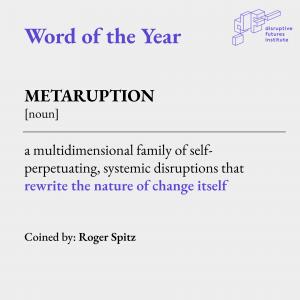
METARUPTIONS – Word of the Year (Disruptive Futures Institute)
Roger Spitz Keynote Talk at the Edison Electric Institute (EEI) in Washington D.C.

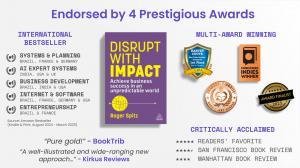
Disrupt With Impact (Roger Spitz, Kogan Page Publishing), Endorsed by 4 Awards
As the Environment Spitz Mapped in 2019 Hits Inflection Point, Disruptive Futures Institute Scales Geopolitics Center; Spitz Ranked #6 in National Security
Washington is the new Silicon Valley. The Three Gs no longer operate in parallel – they collide. That collision is a metaruption, and it is the operating environment for the rest of the decade.”— Roger Spitz, Chair Disruptive Futures Institute
SAN FRANCISCO, CA, UNITED STATES, July 18, 2026 /EINPresswire.com/ — The Disruptive Futures Institute (DFI) today disclosed the extent to which the term Metaruptions has spread. First introduced by Roger Spitz in 2019, the word now appears in writings on geopolitics, military strategy, national security, cyber risk, artificial intelligence, government foresight, and development policy—often penned by authors who have no background in the foresight field.
Formalized across the Disruptive Futures Institute’s publications from 2020 to 2024, Metaruptions describe multidimensional, self-reinforcing systemic disruptions in which technological breakthroughs, ecological shifts, geopolitical frictions, societal transformations, and human evolutions intersect and compound in unpredictable cascades. What began as a specialized concept for making sense of complex change has, seven years later, become a straightforward description of today’s operating reality.
The recognition mirrors this same evolution. Thinkers360, the thought-leadership ranking platform, now lists Spitz at #6 worldwide in National Security—a top‑10 ranking that joins his existing positions in artificial intelligence, emerging technologies, leadership, management, and risk management.
“We are past the point of simple volatility,” says Spitz, Chair of the Disruptive Futures Institute. “As we enter the second half of the decade, we are navigating Metaruptions – deep, interdependent, transdisciplinary system shifts arising from technological, ecological, geopolitical, economic, and societal convergence.”
WHY NOW: THE INFLECTION POINTS ARRIVE
Metaruptions is being adopted now because the conditions it named are no longer nascent. Change, as Spitz has written, tends to be slow, difficult, and unevenly distributed—while the pace of disruption is rapid, and tipping points can cascade swiftly.
The drivers Spitz identified in 2019 were signals: climate, technology, and AI moving toward irreversibility; complexity, society, and information shifting the underlying paradigms; quantum computing and geopolitical realignment opening new eras. Several are now hitting inflection points simultaneously, compounding forces that spill into tipping points. The vocabulary is spreading because the phenomenon has arrived.
FROM A FORESIGHT PAPER TO THE STRATEGY LITERATURE
In Military Strategy Magazine (Winter 2026), U.S. Army War College authors Aaron Blair Wilcox and Chase Metcalf cite Spitz’s Journal of Futures Studies article “The Future of Strategic Decision-Making” (2020) in their examination of AI and wargaming. Their conclusion: the U.S. Army must promote planning systems that are antifragile—“systems that improve under chaos”—rather than trade the human system of mission command for a fragile algorithmic one.
At the United States Military Academy at West Point, Chris Mayer, Director of Philosophy, evaluated “Disrupt With Impact: Achieve Business Success in an Unpredictable World” and highlighted Spitz’s discussion of “Disruption 3.0”—the cascading effects of interconnected changes that defy linear thinking—alongside the 6 i’s toolkit (Intuition, Inspiration, Imagination, Improvisation, Invention, and Impossible).
The pattern repeats across regions and fields. In Germany, IDOS applied the term directly to geopolitical analysis, assessing in a 2024 Policy Brief the direct and indirect repercussions of a “metaruption” caused by the United States. In the UK, the National Preparedness Commission’s work on moving from prediction to strategic foresight reproduces the definition. In Latin America, Spanish-language cyber strategy research has used Spitz’s Complex Five risk metaphors—the black jellyfish, the black elephant—to model AI-automated offensive operations. Additional citations appear in Greek government foresight, military AI research, tech diplomacy from a Global South perspective, strategic planning journals in Turkey, and a Millennium Project report on the futures of work.
Each of these references emerged independently, in a different language, discipline, or institution.
STRATEGY IS ONE STREAM AMONG MANY
Beyond strategy, a Forbes contributor named ‘Metaruption’ a Word of the Year for 2026 (subsequently translated by Forbes Japan), and the International Training Centre of the ILO opens its 2026 Futures Toolkit on the future of work with the term. Professional bodies and media from finance, accounting, engineering, and other sectors have embraced it; the word now circulates in Japanese, Brazilian Portuguese, French, Spanish, and Korean. British artist Dylan Gill even discovered it while searching for a title for his painting Metaruptions.
Metaruptions describe an era rather than a sector or a threat category—the same mechanics that reshape geopolitics also reshape industries, professions, information, and culture, which is why the term appears in a policy brief and on a painting in the same year.
GEOPOLITICS OR METARUPTIONS?
With Metaruptions, geopolitics no longer hinges solely on diplomacy or military posture. The landscape is hybrid and liminal—shaped by supply-chain exposure, technology bottlenecks, weaponized trade regimes, and contested control of critical resources. Multipolarization deepens uncertainty by posing questions that orderly geopolitics can no longer answer.
THE ANATOMY OF A CASCADE
How do seemingly unrelated events interact? Metaruptions are defined by structural, interacting discontinuities that constantly reconfigure the environment. A shift in geotechnology—a breakthrough in quantum encryption, for example—can trigger a geoeconomic shock, such as a loss of confidence in digital financial infrastructure, which in turn creates geopolitical instability through a breakdown in diplomatic transparency and trust. These interactions evolve in complex, nonlinear, and sometimes chaotic ways, setting off feedback loops that alter everything that follows.
That cascade is no longer hypothetical, which is the subject of Spitz’s newest frontier keynote, “The Quantum Metaruption: AI, Cyber Convergence, and the Antifragile Leadership Shift.” Quantum has moved from research labs to the board agenda. Under ‘store now, decrypt later’ tactics, sophisticated actors are already harvesting encrypted data, making today’s information retroactively vulnerable once meaningful quantum capability arrives—possibly within five to ten years.
THE DFI GEOPOLITICS CENTER FOR GRAND STRATEGY
The citations reflect a shift the Disruptive Futures Institute formalized with its Geopolitics Center for Grand Strategy, which equips CEOs, boards, policymakers, and investors to operationalize Anticipatory Governance across the Three Gs*—through to Info-Ruption, the term Spitz coined for the radical change in worldwide data dynamics that weaponizes information. “The importance of epistemic security and cybersecurity is now comparable to that of national security,” he writes in Disrupt With Impact.
*“Three Gs” – Geopolitics, Geoeconomics, and Geotechnology.
THE AAA FRAMEWORK: WHAT TO DO ABOUT IT
Metaruptions anchor the AAA capabilities introduced in the same 2020 paper the strategy literature now cites—Antifragile, Anticipatory, Agility. The AAA Framework emphasizes future-preparedness rather than prediction, helping leaders continue making decisions as conditions reconfigure.
Metaruptions do not tell us what will happen. They tell us what kind of imagination the moment demands.
For media inquiries and interviews: media@disruptivefutures.org
For speaking inquiries, or to view Roger Spitz’s speaker reel and book a keynote: https://www.disruptivefutures.org/speaking
###
APPENDIX: MEDIA BRIEFING NOTES FOR EDITORS
This briefing pack from Roger Spitz and the Disruptive Futures Institute’s body of work provides contextual materials and provenance for editors and partners covering sample citations, the Three Gs, and the Metaruptions and AAA frameworks. Citations reflect independent references by the authors named; they do not imply institutional endorsement.
SELECTED CITATIONS: MILITARY, SECURITY, POLICY & ACADEMIC
A representative sample of the cross-disciplinary adoption of Spitz’s frameworks, not a complete record:
• Military Strategy Magazine (Winter 2026): Wilcox, A. B. & Metcalf, C., “AI Command and Staff – Operational Evidence and Insights from Wargaming,” Vol. 10, Issue 4, pp. 4-10, citing Spitz (2020) on antifragile planning systems. https://doi.org/10.64148/msm.v10i4.1
• Chris Mayer, Director of the Department of English and Philosophy, U.S. Military Academy at West Point, reviewed Disrupt With Impact (Futures Empowered), highlighting ‘Disruption 3.0’ and the 6 i’s toolkit.
• IDOS (German Institute of Development and Sustainability): Klingebiel, S. & Baumann, M-O., “Trump 2.0 in Times of Political Upheaval?”, Policy Brief No. 24/2024 – applying “metaruption” (Spitz, 2024) to geopolitical analysis.
• National Preparedness Commission (UK): From Prediction to Strategic Foresight – carries the metaruptions definition in work on systemic resilience.
• Presidency of the Greek Government: Dimitris Dimitriadis, Special Secretariat for Strategic Foresight – in work and public commentary on horizon scanning and anticipatory governance, referencing the 6 i’s framework (Spitz, 2024).
• Cyber risk management (Spanish-language, Latin America): Cano M., J. J., Universidad de los Andes – ISLA 2025 Proceedings, deploying Spitz’s black jellyfish and black elephant risk metaphors to AI-automated cyber operations; and the RAFA model (Springer, 2023) on antifragility in cyber risk.
• Military AI systems: Maathuis, C., “Towards Modelling Military Disadvantage in Military Operations,” IEEE CAIT 2025, Huizhou.
• Global Policy / tech diplomacy: Garcia, E. V., “Technology for Whom and for What? A Global South View of Tech Diplomacy,” Global Policy (2025).
• Management Decision: Biloslavo, R., Edgar, D., Aydin, E. & Bulut, C., on AI and strategic planning in VUCA environments, citing Spitz (2020).
• MANAS Journal of Social Studies (Turkey, April 2026): Yiğitol, B., comparative study on human managers and AI in strategic decision-making, citing Spitz (2020).
• Millennium Project / Futures of Technologies Conference 2025: Di Berardo, M., Heinonen, S., Taylor, A., Viitamäki, R. et al., “Exploring Socio-Technical Futures of Work,” citing Spitz (2024) on convergence, emerging fields, and the tempo of disruption.
RANKINGS & RECOGNITION
• Thinkers360 – National Security: Roger Spitz ranked #6 globally, a Top 10 placement.
• Global Gurus (2026): #15 in the World’s Top 30 Futurist Professionals, a cohort including Ray Kurzweil, Peter Diamandis, and Michio Kaku; Spitz and the Disruptive Futures Institute also selected for the Top 30 Global Gurus Training Programs and Keynotes to Manifest Real Change.
• Speaker recognition: Ranked the #1 futurist keynote speaker for disruption, foresight, and artificial intelligence by leading agencies, media, and international platforms; featured in Speakers Associates’ 2026 buyer’s guide to AI keynote speakers (“AI Strategy and the Board Agenda”) alongside Cassie Kozyrkov and Daniel Susskind.
CREDENTIALS BEHIND THE GEOPOLITICS PRACTICE
As Global Head of Technology, Aerospace & Defense M&A at BNP Paribas, Spitz advised on 50+ transactions valued at $25 billion across defense, space, cyber, security, and technology, built the bank’s U.S. M&A platform in San Francisco, and launched its European Digital Corporate Finance practices.
He has since fortified the practice with Professional Certificates from King’s College London (King’s Institute for Applied Security Studies) in Grand Strategy; Artificial Intelligence in National Security; Strategic Communications; Wargaming and Strategy; and Security Threats & Challenges. He contributed the AAA Framework chapter to Anticipatory Governance: Shaping a Responsible Future (World Scientific, Singapore, 2025).
THE DFI GEOPOLITICS CENTER FOR GRAND STRATEGY
Focus areas, also available as deep-dive keynotes and masterclasses for leadership forums:
• Systemic Risk & Global Disorder: navigating the erosion of consensus and fragmentation of order.
• The Three Gs: decoding the collision of geopolitical, geoeconomic, and geotechnological forces.
• Grand Strategy: applying non-linear, asymmetric strategies to thrive in unpredictability.
• Geofinance: managing capital flows, systemic shocks, and the geopolitics of finance.
• Info-Ruption & Epistemic Security: protecting information integrity and decision-making agency in the age of AI.
The Center sits alongside DFI’s AI, Metaruptions, and Nature & Climate Centers, and informs the ‘INSTABILITY’ (geopolitics and grand strategy) and ‘UNCERTAINTY’ (predictability, risk, finance) special editions.
Geopolitical themes now anchor a growing share of Spitz’s keynote calendar, masterclasses, and writing, with the Three Gs increasingly the organizing frame requested by boards and policy audiences.
SPOTLIGHT: THE QUANTUM METARUPTION KEYNOTE
“The Quantum Metaruption: AI, Cyber Convergence, and the Antifragile Leadership Shift” – keynote part of the “Futures of…” Frontier Series, which spans algorithmic intelligence, quantum horizons, synthetic biology, the next energy supercycle, and the new space economy.
Quantum has moved from the research lab to the board agenda. Sophisticated state and non-state actors are already operating on a “store now, decrypt later” basis, rendering today’s encrypted data retroactively vulnerable the moment meaningful quantum capability arrives; data encrypted under present standards may be readable within a five-to-ten-year window.
METARUPTIONS: DEFINITION & PROVENANCE
Coined by Roger Spitz in 2019, Metaruptions identify the meta-layer where disruptions begin to disrupt the frameworks we use to