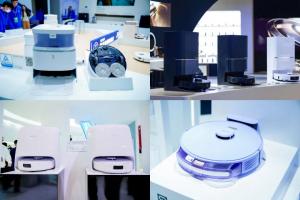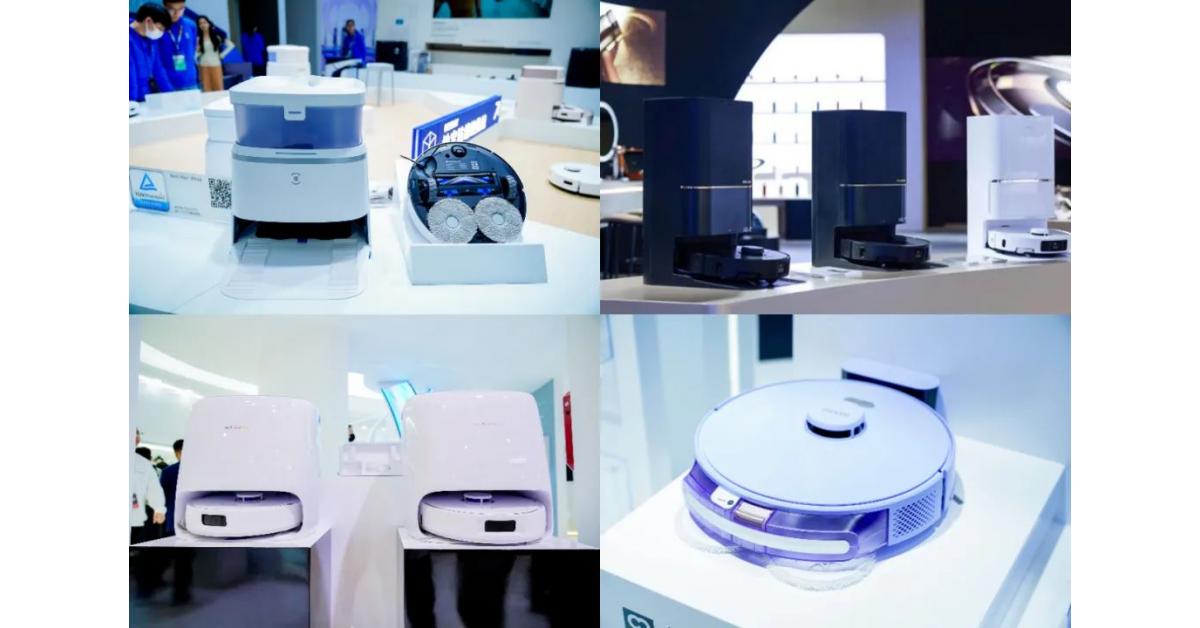
JINHUA, ZHEJIANG, CHINA, July 23, 2026 /EINPresswire.com/ — AWE 2025 made one thing unmistakably clear for anyone monitoring the floor cleaning sector. Self-cleaning capability is no longer a premium differentiator; it has become a standard requirement for the category. Among the China Best Self-Cleaning Wet And Dry Vacuum Cleaner Manufacturers exhibiting at the event, a clear trend emerged: the upcoming wave of products is not merely about increased power — it focuses on better hygiene, greater responsiveness, and more thoughtful engineering for what happens once the floor is clean. Three key technical areas captured the attention of buyers and product designers: the thoroughness of the cleaning system, the intelligence controlling its operation, and the drying technology that ensures sterilization is truly effective.
What “Next-Generation” Self-Cleaning Really Implies
Trade show terminology evolves rapidly. Phrases like “deep self-cleaning,” “intelligent hygiene,” and “auto-sterilization” were featured on countless product displays at AWE 2025. Evaluating these claims requires clear benchmarks. Three criteria reliably differentiate true technical progress from repackaged features: the temperature range of the cleaning process, the precision of the sterilization approach, and the system’s ability to react to actual dirt levels instead of following a predetermined routine.
By these measures, the difference between basic self-cleaning and top-tier engineering is substantial. Entry-level systems rinse a roller brush with cold water and consider the task complete. Advanced systems use precise heat, targeted chemicals, and sensor-activated timing — resulting in significantly better hygiene outcomes rather than just improved marketing language.
Mid-Range Innovation — Self-Cleaning Moves Downmarket
One of the most notable trends at AWE 2025 was the integration of self-cleaning technology into mid-range products. This shift is important because it raises the baseline expectation for the entire category, not just the premium segment.
CGH (Jinhua Chunguang Technology Co., Ltd.) exemplifies this development with the Model 2350. This unit features a BLDC 120W motor operating at 150W total power, generates 15kPa of suction, and includes automatic roller brush self-cleaning via the base station. The design also incorporates deliberate noise reduction and real-time voice status updates — features once reserved for higher-margin products. Wireless functionality with base charging adds practical convenience. Taken together, these specifications deliver a clear message: affordable pricing no longer means sacrificing self-cleaning capability or core user experience. The 2350 represents the type of product that redefines consumer expectations across an entire market segment.
Premium Innovation — The Boiling Water and Electrolytic Sterilization Standard
At the high end, AWE 2025 showed just how far the self-cleaning benchmark has advanced. The key development: combining 100-degree Celsius boiling water with electrolytic water generation built directly into the roller brush as a unified sterilization approach.
The engineering reasoning behind this combination warrants attention. Conventional electrolytic water systems place the generator in the clean water tank. By the time the electrolytic water passes through the machine’s internal pipes and reaches the roller brush, its hypochlorite ion concentration has decreased. The result is a sterilization effect weaker than the specification suggests. Fixing this requires relocating the generator.
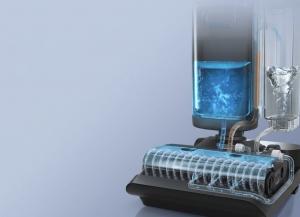
Jinhua Chunguang Technology Co., Ltd. addresses this in the Model 2507 by positioning the electrolytic water generator directly at the roller brush. Water produces hypochlorite ions upon contact — immediately, without traveling through pipes — and delivers them at full strength to the brush surface. Boiling water self-cleaning handles the thermal component: a heated metal plate at the base front raises the cleaning water to 100 degrees Celsius, dissolving grease and organic residue that lower temperatures cannot handle. The entire self-cleaning cycle is completed in under five minutes. This is not a minor enhancement of existing technology. It represents a fundamental redesign of where and how sterilization happens.
The Intelligence Layer — From Timed to Adaptive
Beyond chemistry and thermal engineering, AWE 2025 emphasized another aspect of self-cleaning progress: the move from timer-based operation to condition-responsive behavior. A machine that runs the same self-cleaning cycle regardless of actual dirt levels wastes time and resources on light cleaning sessions while potentially under-cleaning after heavy use.
The CGH 2507 tackles this with infrared dirt detection sensors embedded within the cleaning pipeline. In intelligent mode, the system continuously monitors contamination levels. It adjusts suction power, water output, and — critically — the duration of the self-cleaning cycle and the number of forward-reverse roller brush rotations based on what the sensors detect. The BLDC motor operates at 115,000 RPM with 24,000Pa maximum suction pressure, and power output automatically scales between 90W and 120W depending on the soil load. This sensor-to-motor feedback loop allows the machine to tailor its behavior to real-world conditions rather than fixed settings. For OEM buyers, this kind of integrated intelligence offers a powerful product positioning advantage.
Drying Engineering — The Critical Final Step for Hygiene
Self-cleaning systems that leave moisture in the roller brush create an environment for bacterial regrowth. This is the aspect of hygiene that specifications often downplay. A machine can sterilize effectively yet still produce odors and bacteria if drying is incomplete or takes too long for users to wait through consistently.
The 2507 addresses this with a two-mode drying system. Silent drying mode completes in 90 minutes and operates quietly enough for occupied spaces. Fast drying mode finishes in five minutes — a duration that fits practically into the end of a cleaning session. Both modes activate automatically after a self-cleaning cycle. Neither requires user initiation. Designing drying as an automatic extension of sterilization, rather than a separate step needing deliberate action, reflects a practical understanding of how hygiene compliance works in real homes. Users rarely follow multi-step post-cleaning routines. Systems that eliminate the behavioral requirement yield more consistent hygiene results.
The Manufacturing Foundation for Consistent Innovation
Products like the 2350 and 2507 do not come from factories operating on thin margins without institutional depth. The engineering precision on display — exact thermal management, component-level sensor integration, repositioned electrolytic generators — requires sustained R&D investment and a manufacturing infrastructure capable of turning development into consistent production quality.
CGH provides that foundation. Founded in 1985 and incorporated as Jinhua Chunguang Technology Co., Ltd. in 2000, the company has spent over four decades building manufacturing expertise in the cleaning appliance sector. It holds national high-tech enterprise status, carries intellectual property certification alongside three-system management certification, and completed an A-share listing on the Shanghai Stock Exchange in 2018 — establishing a level of financial governance uncommon among privately held manufacturers. Six production bases across Jinhua, two facilities in Suzhou, Malaysia, and two locations in Vietnam provide the supply chain distribution needed for long-term OEM partnerships. A patent portfolio covering design, utility model, and invention categories demonstrates that product innovation at CGH is tied to protected original engineering rather than specification replication.
Interpreting the AWE 2025 Signals
AWE 2025 made the industry’s trajectory unmistakable. Self-cleaning depth, sterilization precision, sensor-driven adaptability, and drying reliability now define the competitive edge in floor care. Brand teams and sourcing managers translating these trends into next-cycle product strategies need suppliers whose engineering roadmap matches where the category is headed — not where it has been.
The 2350 and 2507 together cover the spectrum from accessible mid-tier to advanced flagship, showing that CGH engineers solutions across the full product range rather than concentrating capability at a single price point. That breadth matters for OEM partners building multi-SKU product lines for different market segments.
Complete product specifications and inquiry contacts are available at http://www.cgh-group.cn/.
Chunguang Technology Co., Ltd.
Chunguang Technology Co., Ltd.
+86 182 6009 8187
email us here